| The Monarchy of Bhutan |
| The Kings of Bhutan |
 |
Bhutan Royal Family The King |
|
|
|
|
The
Monarchy
|

|
The
hereditary monarchy of Bhutan was established in 1907 after 300 years of
dual theocratic-civil government The Druk Gyalpo is both head of state
and head of government. In the process of coming to power, the first Druk
Gyalpo, Ugyen Wangchuck, who reigned from 1907 to 1926, unified the nation,
established friendly relations with Britain, and set his dynasty's political
agenda.
As of 2010, there had been four other hereditary monarchs:
Jigme
Wangchuck (1926-1952),
Jigme Dorji Wangchuck (1952-1972),
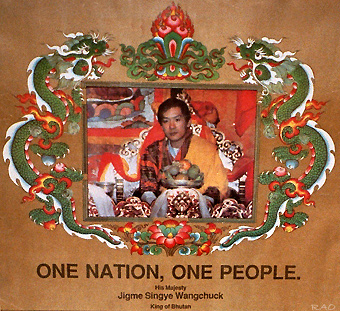
Jigme Singye
Wangchuck (1972-2006), and
2006 HM King Jigme Khesar Namgyel Wangchuck has become the fifth King of Bhutan..
December 17, the anniversary of the day Ugyen Wangchuckbecame the first hereditary monarch in 1907, is Bhutan's National Day.
 |
| Prior
to the establishment of the monarchy, Bhutan followed a dual system of
administration initiated in 1652 by Zhabdrung Ngawang Namgyel.
Under
the Chhoesi system, the Druk Desi looked after the temporal administration
and the Je Khenpo looked after religious matters of the country.
Although
this form of government worked over two centuries, disputes over the succession
to the office brought about increasing strife and instability by the second
half of the 19th century.
Established
as an absolute monarchy in 1907, Bhutan first moved toward a constitutional
monarchy in 1953 with the foundation of its National Assembly. |
|
In
1972 Jigme Singye Wangchuck succeeded his father, Jigme Dorji Wangchuck,
who had involved the young prince in the work of government and had appointed
him crown prince and ponlop of Tongsa only a few months before dying. Jigme
Singye Wangchuck was formally enthroned in June 1974.
| Information on Bhutan |
 |
|