| The Monarchy of Bhutan |
| The Kings of Bhutan |
 |
The Wangchuck Dynasty: The 4th King |
|
|
 |
|
The
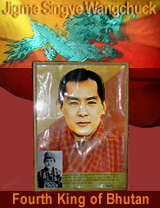
Fourth King - His Majesty Jigme Singye Wangchuck |

|
 |
King
Jigme Singye Wangchuck ascended the throne in 1972. Like his father before
him, the young king at the age of 17 wanted to open and modernize the country
in a cautious manner and has always stressed on the need to foster a balanced
society by promoting tradition, culture and the preservation of the environment.
In
1979 Jigme Singye Wangchuck privately married four sisters who were descendants
of two of the shabdrung, the rulers of the old dual system of government.
In
1988, in order to legitimize the eventual succession to the throne for
his oldest son, Dasho Jigme Gesar Namgyel Wangchuck, the Druk Gyalpo and
his four sisterqueens were married again in a public ceremony in Punakha. |
Considered
a people's monarch in every sense, His Majesty has guided the nation towards
the pursuit of economic self-reliance, cultural promotion, environmental
preservation, regionally balanced development, good governance and decentralization.
Following
the royal decree issued by the king in September 2001, the government of
Bhutan inaugurated the drafting of a Constitution, which is widely seen
as a historic move in the process of political evolution initiated by His
Majesty.
The
process of decentralization was a personal initiative of the king with
the introduction of Dzongkhag Yargye Tshogchungs (DYTs) in 1981, and Geog
Yargye Tshogchungs (GYTs) in 1991. Emotions ran high among the Bhutanese
people when His Majesty devolved all executive authority from the throne
to the cabinet in 1998 introducing a system in which the National Assembly
would elect a Council of Ministers by secret ballot, and direct the National
Assembly to re-introduce the system of a vote of confidence in the King.
| Information on Bhutan |
|
|












