| Celebration
of the centenary of Monarchy 1907-2007 |
 |
Bhutan Royal Family Reports |
|
|
|
 |
  |
|
 |
|
 |
|
 |
| His
Majesty the King advised the Cabinet that the celebrations planned by the
government to mark the centenary of the Monarchy in Bhutan should
be held in 2008 because 2006 and 2007 were lona (inauspicious
years) according to the lunar calendar. His Majesty said that there
would be many events to celebrate in 2008 but having too many grand celebrations
would be unnecessarily expensive and the money would be better spent in
development programmes and in establishing the Constitutional institutions
that would be necessary for the success of parliamentary democracy in Bhutan.
His Majesty advised that the centenary of the Monarchy, the adoption of
the Tsathrim, the introduction of general elections, and the installment
of a democratic government could all be combined to save costs.
Because
of the two-year lona (inauspicious years) period, in 2006 and 2007,
His Majesty advised the government to plan and formally inaugurate the
important Constitutional institutions and offices before the lona started.
Source:
KUENSEL |
|
|
|
|
| History
of Monarchy |
 |
Prior
to the establishment of the monarchy, Bhutan followed a dual system of
administration initiated in 1652 by Zhabdrung Ngawang Namgyel.
Under the
Chhoesi system, the Druk Desi looked after the temporal administration
and the Je Khenpo looked after religious matters of the country. Although
this form of government worked over two centuries, disputes over the succession
to the office brought about increasing strife and instability by the second
half of the 19th century.
 A
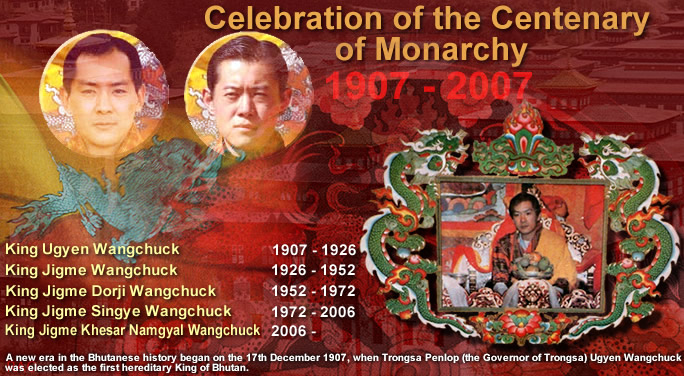
new era in the Bhutanese history began on the 17th December 1907,
when Trongsa Penlop (the Governor of Trongsa) Ugyen Wangchuck was
elected as the first hereditary king of Bhutan. It was a decision taken
unanimously by the clergy, officials, and people acting on their desire
for political stability and internal peace in the country. A
new era in the Bhutanese history began on the 17th December 1907,
when Trongsa Penlop (the Governor of Trongsa) Ugyen Wangchuck was
elected as the first hereditary king of Bhutan. It was a decision taken
unanimously by the clergy, officials, and people acting on their desire
for political stability and internal peace in the country.
Thus, King Ugyen
Wangchuck laid the foundation for the emergence of modern Bhutan, uniting
it under a central authority.
The
nation continued to enjoy peace and stability under the reign of the second
king Jigme Wangchuck who succeeded him in 1926 and ruled the country
till 1952.
At the age of 15 Ashi Phuntsho Choden was enthroned as the Queen of the second Druk Gyalpo King Jigme Wangchuck. In 1928, at the age of 18, she gave birth to the third Druk Gyalpo, His Majesty King Jigme Dorji Wangchuck, at Thrupang Palace in Trongsa.
The third Druk Gyalpo King Jigme Dorji Wangchuck succeeded his father, Jigme Wangchuck, on 27 October 1952.
His Majesty King Jigme Dorji Wangchuck married Her Majesty Queen Ashi Kesang Choden Wangchuck.
The fourth Druk Gyalpo King Jigme
Singye Wangchuck ascended the throne in 1972. Like his father before
him, the young king at the age of 17 wanted to open and modernize the country
in a cautious manner and has always stressed on the need to foster a balanced
society by promoting tradition, culture and the preservation of the environment.
Considered a people's monarch in every sense, His Majesty has guided the
nation towards the pursuit of economic self-reliance, cultural promotion,
environmental preservation, regionally balanced development, good governance
and decentralization.
Following
the royal decree issued by the king in September 2001, the government of
Bhutan inaugurated the drafting of a Constitution, which is widely seen
as a historic move in the process of political evolution initiated by His
Majesty.
The process of decentralization was a personal initiative of the
king with the introduction of Dzongkhag Yargye Tshogchungs (DYTs) in 1981,
and Geog Yargye Tshogchungs (GYTs) in 1991.
Emotions ran high among the
Bhutanese people when His Majesty devolved all executive authority from
the throne to the cabinet in 1998 introducing a system in which the National
Assembly would elect a Council of Ministers by secret ballot, and direct
the National Assembly to re-introduce the system of a vote of confidence
in the King.
December 14, 2006
The fourth Druk Gyalpo, His Majesty Jigme Singye Wangchuck, has handed over his responsibilities as the Monarch and head of state of Bhutan to the Crown Prince Jigme Khesar Namgyel Wangchuck who now assumes the full responsibilities of head of state as the fifth Druk Gyalpo.
On 13 October 13, 2011 the fifth Gyalpo married Jetsun Pema as the Druk Gyaltsuen (Queen of Bhutan).
| Information on Bhutan |
|
 |
| Tashichhodzong |
|