| Reports
on Nepal's Civil War |
November
2005
| Nepal's
war widows see red |
Red
is no longer just the colour of revolution, it also a symbol of women's
empowerment
One
month into the Maoist's unilateral ceasefire and two months to go, the
people along the trails leading north from Okhaldhunga towards Solu are
still reluctant to talk.
There
is a resigned air as teashop owners, farmers and women collecting fodder
shake their heads and refuse to speak to strangers. At Jantarkhani, a trader
mutters under his breath: "Hard to tell who is a Maoist and who's a monarchist.
Despite the ceasefire I am still forced to give rice to the guerrillas
and then the soldiers come and kick me because I fed them."
November
2005
| Ceasefire
or no ceasefire - Line of control |
Ceasefire
or no ceasefire
It
doesn't seem to make much of a difference in the Maoist heartland.
Even
though there is still a month to go for the unilateral Maoist ceasefire
to end, tensions are already running high in these remote mountains where
the Maoist war started nearly ten years ago.
There
is nervousness on both sides and even a small incident could spark a premature
end to the ceasefire. The rebels have been engaged in psywar with messages
to the CDO and local security officials warning of an imminent attack.
The Unified Command, meanwhile, has been sending patrols deeper into the
Maoist-held hinterland.
Line
of control
All
is quiet on the western front, but for how much longer?
With
only a month to go before the Maoists' unilateral ceasefire ends, a lone
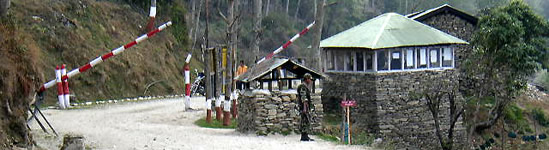
policeman this week guards the barbwired and landmined perimeter of Khalanga,
the capital of Rukum. He hasn't seen any Maoists lately, just people streaming
in and out for the festivals.
This
sandbagged sentry post is as far as the government's writ goes in this
midwestern district where the Maoist rebellion started 10 years ago. The
ceasefire has brought down the daily death count in the war, development
activities have picked up and political parties in many places find the
situation more relaxed.
October
2005
| Ceasefire
eases tensions in Nepal |
Dhangadhi
has suffered more insecurity than any other large town
Maoist
rebels fighting Nepal's government are now more than half-way through the
three-month ceasefire they called in early September.
The
government, which King Gyanendra has led since seizing power in February,
has refused to reciprocate the truce, saying it mistrusts the rebels' intentions.
There
have been continuing reports of the army killing Maoists or Maoist suspects,
sometimes unprovoked; and of the rebels victimising and sometimes killing
civilians.
But
the level of violence is markedly down, for instance in Kailali, a district
very heavily affected by the insurgency.
October
2005
One
month into the Maoist's unilateral ceasefire and two months to go, the
people along the trails leading north from Okhaldhunga towards Solu are
still reluctant to talk.
There
is a resigned air as teashop owners, farmers and women collecting fodder
shake their heads and refuse to speak to strangers. At Jantarkhani, a trader
mutters under his breath: "Hard to tell who is a Maoist and who's a monarchist.
Despite the ceasefire I am still forced to give rice to the guerrillas
and then the soldiers come and kick me because I fed them."
October
2005
Last
week we travelled to Chingar in western Nepal, hoping to interview some
Maoists who control the area. As we walked on jungle trails outside the
village of Dasrathpur, we spotted a girl in a blue and white school uniform
who approached to tell us she was hiding from Maoists. It was clearly a
cry for help and she was not alone, a boy and a girl in the same uniform
were standing some distance away.
October
2005
Just
about everyone agrees that King Gyanendra is contemplating a new move but
no has a clue what it will be.
Trial
balloons from the royal regime could indicate he is considering the option
of scrapping the constitution altogether, after all there isn't much left
to destroy. Hardline army brass make no secret of their preference for
a ban on parties and still seem to have the king's ear.
More
moderate advisers, however, argue that the royal takeover instead of helping
crush the Maoists has actually put the monarchy in serious jeopardy and
have told the king he should quickly backtrack.
|