|
The
Pazaps: Keeping alive a historical tradition
|
 |
Bhutan Religion |
|
|
 |
|
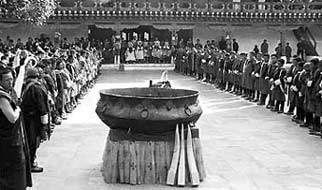
| The pazaps are beeing sent of with an elaborate ceremony |
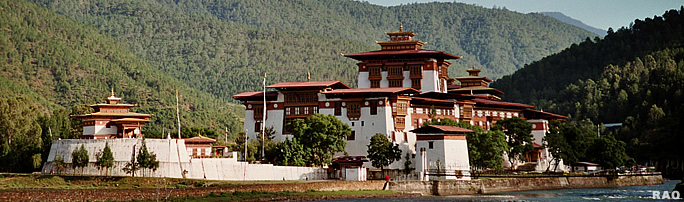
| The Punakha
Dzong resonates with the war songs and sounds of explosions as
the Pazaps sing and throw enormous fire-crackers into the courtyard to
recreate the noise of battle. Dressed in red and black, the 136 Pazaps
represent the soldiers in the Zhabdrung's army (only the people
of western Bhutan belonging to the Wang Tshochengye - the eight
great clans or geogs, situated within the boundaries of the Thimphu and
Punakha regions) can take the role of the Pazaps. |
|
Today
the battle scene is re-enacted during the annual Punakha Domchoe by 17
people forming eight groups led by eight generals (Magpon).
The
generals wear the finest battle garb: ghos with magnificient patterns,
yellow silk skirts with coloured ribbons, and white, blue and red
felt boots. They also wear heavy metal helmets decorated with flags, and
at their sides hang resplendent swords.According
to a spokesman for the Central Monk Body, the ceremony was performed
by the Zhabdrung in 1639 to hoodwink the Tibetan invaders into believing
that the Rangjung Kharsapani had been thrown into the river. The
Tibetans had come to Punakha to forcefully take back the Rangjung Kharsapani
which was brought to Bhutan by Zhabdrung Ngawang Namgyal. Realising
that the sacred relic cannot be recovered from the river, the Tibetan warriors
retreated. Thus the Zhabdrung had won another battle throught craft
and cunning.
top
| Amazing and unique: The last day of the Domchoe |
 |
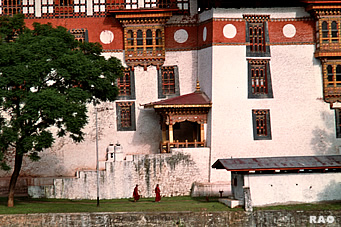 |
| Punakha Dzong |
| On
the last day of the Domchoe each
pazap performs Lengmag dance in front of His
Holiness the Je Khenpo in the great courtyard of the dzong. Then they
leave the dzong in groups shouting and whistling, and gesticulating theatrically
as they descend the great staircase. At the bottom of the staircase, the
generals mount their steeds and gallop away in a cloud of dust in four
directions towards the surrounding areas to protect the religious relics
that are being immersed in the river. |
|
Then
begins a slow religious procession with hundreds of monks and lams wearing
the high red hat of the Drukpa Kagyu order leaving the dzong complex
amid the sound of trumpets and drums.
The
procession stops at the river bank where His Holiness the Je Khenpo with black hat and great apron decorated with the fearsome head of Mahakala
performs the Luu Chok (religious ceremony for sub-surface spirits) and throws a handful of oranges into the river symbolising the precious
relic, Rangjung Kharsapani - the self created image of Chenrezig
or Avoleketeshvara. His Holiness represents the Zhabdrung, who
performed the same ceremony on this spot in the 17th century.
After
the symbolic immersion of the relic the Pazaps return with triumph. At
the foot of the stairway leading into the dzong, the generals are pulled
off their horses and carried in triumph up the stairs into the courtyard
where the day of victory ends with celebrations.
One
of the oldest and most popular in the country, the Punakha Domchhoe is
attended by thousands of people from all over the kingdom and many tourists. It
is being held from the 24th day of the 12th Bhutanese month to the 9th
day of the 1st Bhutanese month every year.
The war cries of the Pazaps, the sound of fire-crackers and the ceremonial
procession (serdang) for a symbolic immersion of relic into the Mochu
river are the highlights of the Punakha Domchhoe.
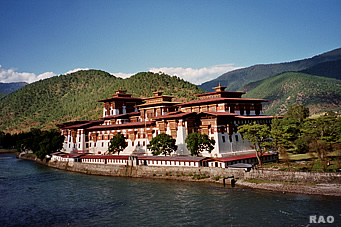 |
| Punakha Dzong |
| Unlike
Tshechus in various parts of the country which are dominated by the mask
and folk dances Punakha devotes several days to ritual ceremonies (Goenwang
Drubchog) appeasing Yeshey Goenpo or Mahakala, the protecting
deity of Bhutan.
According
to the Dorji Lopon of the Central Monk Body, Yonten Gyaltshen, the Punakha
Domchhoe, introduced by Zhabdrung Ngawang Namgyal, is an expression
of gratitude to all forms of protecting deities (Goenpos) from enemies
and invasions. |
|
The
three-day Domchhoe is preceded by an eleven-day Goenwang Drubchog which was performed by His Holiness the Je Khenpo and more than
250 monks in the Dhukhang (congregation hall). During the Drubchog the
monks perform religious ceremonies, the Black Hat dance, and many
other sacred dances in the Dhukhang. But the three-day festival is dominated
by the Pazaps.
A
tourist described the Punakha festival as amazing and unique. "On the first
day of the festival I saw some masked dances in the courtyard which were
very spiritual," a French tourist told. "But I was also deeply moved and
fascinated by the Bhutanese warriors which is very historical and different
from other festivals."
| This
article was contributed by KUENSEL, Bhutan's National Newspaper |
 |
| Information on Bhutan |
|
|