A
small mountainous kingdom located in the eastern Himalayas between the
giants of China (Tibet) to the north and India to the east, south and west
stretches from 150 km from north to south and 300 km from west to east,
covering about 47,000 km2.
With
an estimated population of 658,000 in 2000, according to the Central Statistical
organisation, the population density of Bhutan is among the lowest in Asia,
and there still remain large tracts of unoccupied land.
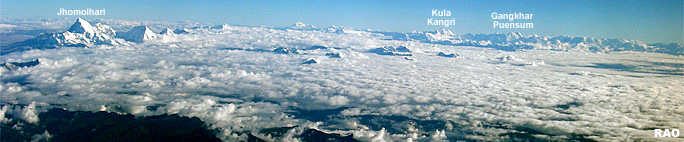
Major
mountain peaks
Kula
Kangri (7554 m)
Gangkhar
Puensum (7,541 m)
Jhomolhari
(7,314 m)
Bhutan
has many different ethnic groups, the Ngalops, the Sharchops ("people
of the east"). and the Lhotshampas ("people of the south"). The Bhotes (Ngalops and the Sharchops) are mainly Buddhists and are
concentrated to the western and eastern Bhutan. The Lhotshampas (one of several Nepalese ethnic groups) who are the Nepali-speakers and are comprised primarily of Hindus and animists are concentrated
to the south of Bhutan. Bhutanese are friendly and hospitable people.
According
to the 2005 Population and Housing Census of Bhutan, the population
of Bhutan is 634,982. The census does not provide population statistics
by ethnicity. The census classified 13 percent of the Bhutanese residents
as "non-nationals".
Estimates
of the ethnic breakdown of the population range from 10 to 28 percent for
the Ngalongs, 30 to 40 percent for the Sharchhops, and 25
to 52 percent for the ethnic Nepalis.
The
politically and culturally dominant Ngalongs, who live mainly in
the central and western regions of Bhutan, are of Tibetan descent; their
ancestors arrived in Bhutan in the eighth and ninth centuries. The Ngalongs
speak Dzongkha and follow the Drukpa Kagyu school of Tibetan
Buddhism, which is Bhutan's state religion.
The Sharchhops,
who live in eastern Bhutan, are descendants of the earliest migrants to
arrive in Bhutan. The Sharchhops are of Indo-Burmese origin, speak Tshangla (which is closely related to Dzongkha) and follow the Nyingma school
of Tibetan Buddhism. Together the Ngalongs and Sharchhops are known
as Drukpas.
The
third major group, who differ greatly from the Drukpas in terms
of culture, language, and religion, are ethnic Nepalis in southern
Bhutan. The ethnic Nepalis speak Nepali and are predominantly Hindu.
About
85% of the population live in scattered rural villages, homesteads and
farms. Settlements have generally occurred in relatively flat areas, where
climatic conditions are moderate. Migration from rural to urban centers,
and the subsequent emergence of urban characteristics such as multi-storied
buildings, restaurants, streets, shops, hotels and hospitals only began
in the early 1960s. Today about 15% of the population dwells in urban townships
like Thimphu, the capital, and Phuentsholing, a border town with India
that is Bhutan's commercial hub.
The modern Dzongkha writing uses the alphabet system first introduced by Thonmi Sambhota. Son of Anu of the Thonmi clan from central Tibet, Sambhota was the most intelligent minister of the religious Tibetan king Songtsen Gampo (Srong-btsan-sgam-po). He was believed to be an emanation of Manjushiri, the Lord of wisdom. The king sent Sambhota with fifteen other young Tibetans to study Sanskrit in India. Sambhota studied linguistics at the feet of Pandita Devavidhayasinha and Brahmin Lipikara of Kashmir. Since he was the brightest student, his teachers called him "Sam-bhota" meaning "best Tibetan".
Although the writing system (namely Jogyig) was brought to Bhutan by Dematsema (ldanma-Tsemang) on the invitation of Sindhu Raja, the origin of the Bhutanese alphabet has to be traced back to Sambhota since the jogyig is also based on his alphabet.
In
the Thunder Dragon Kingdom adorned with sandalwood
The
protector who guards the teachings of the dual system
He,
the precious and glorious ruler, causes dominion to spread
While
his unchanging person abides in consistency
As
the doctrine of the Lord Buddha flourishes
May
the sun and peace of happiness shine on the people!
The
state religion is the tantric form of Mahayana Buddhism that originates
from Tibet. The Bhutanese are very religious, and Buddhism significantly
influences their values, shaping the vast majority of the country's institutions,
arts, architecture and literature.
The Ngalongs follow the Drukpa Kagyu school of Tibetan Buddhism, which is Bhutan's
state religion. The Sharchhops follow the Nyingma school of Tibetan
Buddhism. The ethnic Nepalis are predominantly Hindu.
The
rectangular national flag of Bhutan is diagonally segmented and depicts
a white dragon across the middle. The upper part of the flag is golden
yellow, which represents the secular power of the king, while the lower
part is orange, which is indicative of the Buddhist influence. The dragon,
whose white color is associated with purity, represents Bhutan. It holds
jewels in its claws which represent the wealth and perfection of the country.
The
national emblem, contained in a circle, is composed of a double diamond
thunderbolt placed above a lotus, surmounted by a jewel and framed by two
dragons. The double diamond thunderbolts represents the harmony between
secular and religious power; which results from the Buddhist religion in
its Vajrayana form. The lotus symbolizes purity; the jewel - sovereign
power; and the two dragons, male and female, stand for the name of the
country - the thunder.
The
national day is celebrated on the 17th December in commemoration of the
ascension of Ugyen Wangchuk, the first king of Bhutan to the throne, at
Punakha Dzong.
The
Wangchuck Centennial Park, launched in 2008, house many species of
national significance such as the national tree Cyprus (Cupressus corneyana),
national animal Takin (Budrocas taxicolor), national bird Raven (Corvus
corax) and national flower Blue Poppy (Meconopsis grandis).
The Jigme
Dorji National Park with an area of 4350 km2 is the largest protected
area system in Bhutan.The Wangchuck Centennial Park (WCP) is the second
largest park in Bhutan. The 2008 launched WPC is covering areas of 3736
km2 in the four districts of Gasa, Trongsa, Bumthang and Lhuentse. The
Wangchuck Centennial Park will increase the protected areas system of Bhutan
from 36% to 49.22% of the the country's territory.
The
staple diet of the Bhutanese people is red rice, buckwheat, wheat, maize,
pork, beef, chicken, yak meat, cheese and chillies which the Bhutanese
people consider a vegetable and not as spice.
Agriculture
and livestock raising is the mainstay of the economy. It contributes about
45% to the Gross National Product (GNP). More than 90% of the people live
on subsistence farming. The farms are narrow pieces of land cut into terraces
on hill slopes. Forestry contributes 15% to the GNP and industry and mining
10%.
Bhutanese
men wear gho which are longish robes tied around the waist by a cloth belt
known as kera. The women's ankle length dress is known as kira which is
made of bright colored fine woven fabric with traditional patterns.
Bhutan
is known for handicraft items in bronze silver and other metals. Sculpting
of religious figures is widely practiced and every temple contains large
brightly painted and gilded statues of Buddha and other saints.
The
castle like dzongs with their gently tapering walls, classic lines, large
courtyards and beautiful galleries are among the finest example of Bhutanese
architecture. Containing large monasteries inside and set in commanding
position on hilltops or at the confluence of rivers, dzongs are also the
administrative centers of their religions. But the most common architectural
sight in Bhutan are the chortens or stupas which are small shrines built
to house sacred relics.
The
national sport of Bhutan is archery. Other traditional sports include degor
- a kind of shot put, darts and wrestling. Today most international sports
such as soccer, basketball, volleyball, tennis and table tennis are becoming
popular.
Kuensel,
the government newspaper, is publihed in Dzongkha, English and Nepalese.
The editions are published on a weekly basis.
Bhutan
Times, private weekly newspaper
Bhutan
Observer, private weekly newspaper
The
Bhutan Broadcasting Service is the government owned radio and television
station which broadcasts news in English, Dzongkha and Nepalese. Since
1999 there have been a few hours of television daily
The
Government has invested heavily in improving the social sector. Under the
Ninth Five Year Plan (2002-2007) education was allocated 15 percent of
government outlay; in 2006-2007, the education sector accounted for 18
percent of the government budget.
The
Bhutan school system is divided into four stages ...
primary
and pre-primary, lower secondary, middle secondary and higher secondary
As of June 2008, the total length of roads built stands at 5362 km (including 528.90 km of forest roads, 554.20 km of access roads, and 140.8 km of power tiller tracks) with Chhukha Dzongkhag having the largest share of it with 534.6 km accounting for 10.0% of the total road network followed by Thimphu andMongar Dzongkhags with 452.7 km (8.4%) and 431.7 km (8.1%) respectively. Gasa remains the least road networked Dzongkhag with only 36.6 km (0.7%) followed by Pema Gatshel and Tsirang Dzongkhags with 108.2 km (2.0%) and 124.9 km (2.3%).
2008, there are over 5362 km of roads of different categories comprising of 1634.3 km of national highways, 482 km of district roads, 820.7 km of feeder roads, 163 km of urban roads, 1045.6 km of farm roads, 528.9 km of forest roads, 547.2 km of access roads (i.e. the roads which provide access to religious, cultural, educational and social institutions, projects, state properties, etc.) and 140.8 km of power tiller tracks.
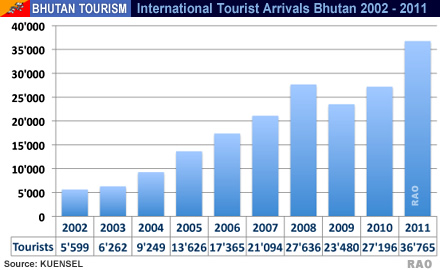
The tourism industry earned USD 47.68M from dollar paying tourists last year, up by 32.52 percent from the previous year. Of this, royalty generate USD 14.89M.
Tourism council officials said these earnings do not include revenue from other sectors like airline, handicraft, and out-of-pocket spending.
Last year a total of 65,746 high-end tourists visited Bhutan.