 |
Bhutan's
Religion |
|
|
 |
|
The
Sipa-Chi-Doe in Mongar |
Thousands
of people from the six eastern dzongkhags are gathered in Mongar to attend the Sipa-Chi-Doe and Damsi Torma, considered the most
important ceremonies in Bhutanese religious tradition and, for most devotees,
a blessing which they are fortunate to receive just once in their
lives.
 |
|
Je
Khenpo |
|
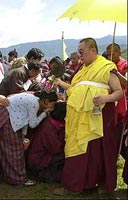
| The Sipa-Chi-Doe, a sacred offering to all the realms of the universe,
is performed by His Holiness the Je Khenpo and more than 500 monks
and gomchens for the peace, security, and well being of the nation
and people. The ceremony, being conducted for the first time in eastern
Bhutan, began on April 14, and concludes tomorrow, the 29th day of
the second Bhutanese month. His Holiness and the clergy are performing
the Vajrayana practices of Ngak (recitation of mantras), Tingye
Zin (meditation), and Chhaja (hand movement) every day
from 4.30 am to 9.00 pm. The nine days of ceremonies will conclude tomorrow
with the symbolic offering made at the Doe (a great altar representing
the universe) which comprises two towering representations of the
two main protecting deities of Bhutan, Goembo (Mahakala) and Pelden
Lhamo (Mahakali). |
|
Dratshang
Lhentshog
The
holy structures of the Doe are adorned with offerings representing every
aspect of material and spiritual wealth and life forms found in the universe,
from harvests to precious jewels and religious images. According to Ngawang
Phue-ntsho, deputy secretary of Dratshang Lhentshog (Council for
Religious Affairs), the Sipa-Chi-Doe was sponsored and organised
by the nation's business community for the peace and security of the
nation and the well being of His Majesty the King and the Bhutanese people.
During the final dissipitation of offerings on Sunday, thousands of people
are expected to rush to the Doe and dismantle the entire physical
structure to take home every piece of the spiritual and material
offerings, from handfuls of earth and grain to religious and material
offerings.
The Sipa-Chi-Doe and Damsi Torma offering is made to all the
deities and beings of the universe to balance the forces of good
and evil. The great Bhutanese Lamas of the past had prophesised that
this sacred offering ceremony would protect the nation against all
threats, uphold religious traditions, safeguard the degeneration
of spiritual values, and ensure peace and prosperity in the country.
The significance of the Sipa-Chi-Doe, initiated by Guru Rinpoche, is explained
in the scriptures of Kuenkhen Pema Karpo. It has been performed in Bhutan
since the time of Zhabdrung Ngawang Namgyal. The last Sipa-Chi-Doe was
performed in Punakha in 1998.
A
representative of the Dratshang Lhentshog said that the offering is made
to all the deities and beings of the universe to balance the forces
of good and evil. "We hope that the Sipa-Chi-Doe and Damsi Torma
kurims will protect the country and benefit the people," he said.
Meanwhile, His Holiness the Je Khenpo will perform Tangra, special offering
to nation's three protective deities, on Monday and the immersion of the
sacred mandala into the Kurichu river on Tuesday, followed by a Throm
Wang (public blessing) on Wednesday. His Holiness will also visit
Autsho, in Lhuentse dzongkhag, on April 26 to consecrate 108 chhortens
built by the people of Kurtoe and Mongar dzongkhags with financial
support from Lam Tshering Wangdi. His Holiness the Je Khenpo, who
left Punakha on April 4 to perform Sipa-Chi-Doe and Damsi Torma kurims
in Mongar, will return to Punakha dzong.
| This
article was contributed by KUENSEL, Bhutan's National Newspaper |
 |
| more
information |
 |
|









