|
Bhutanese
Folk , Drum and Mask Dance
|
 |
Bhutan Culture Traditional Dance |
|
Bhutan Information |
|
|
 |
|
Sacred
dances in Bumthang: Ngang Lhakhang
|
 |
| A
dancer performs at the Ngang Lhakhang |
| Ngang
(swan) lhakhang in Chhoekortoe, Bumthang, is better known for some
of the rare and oldest sacred dances in Bhutan. This includes a number
of noblemen dances called Zhey not performed elsewhere in Bhutan.
These
rare dances are performed during the annual two-day festival in December
where family members from Samdang dung and Ngang Lhakhang Chhoejey lineage play a central role. |
|
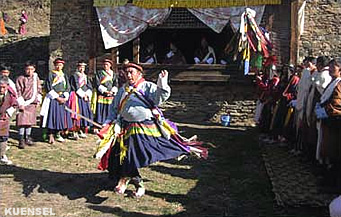 |
Before
the start of the tshechu the protecting deity, Genyen Jagpa Meloen, is
received from the house of dung in Samdang village.
|
| The
people of thedung household lead the eight Zheps (noblemen dancers) and eight Pazaps known as Threps (tax bearers) to the lhakhang.
Enroute
to the lhakhang the people from the Ngang Lhakhang chhoejey lineage receive
the procession.
While
members of the Ngang Lhakhang Chhoejey look after the mask dancers Samdangdung
members take care of the Pazap and Zheps. |
|
During
the festival a member from each lineage are required to attend the entire
tshechu. Until and unless the festival dismisses for breaks, the representatives
of the two families are expected to sit together.
A
woman, known as Dungzam, from the Samdang dung lineage sits at the right
corner of the courtyard with a small traditional table on which is placed
a Dzaphob (fine quality wooden bowl) filled with singchang (local
brew). Her responsibility is to receive important guests and serve
them singchang.
Karma
Leki, 46, from Samdangdung who sits as Dungi Aum said the Dzaphop should
not be left empty. She said that her mother served as Dungi Aum in the
past and now it was her turn.
Thinley,
68, from Samdangdung said that the two families had established the festival.
"Samdangdung are the descendents of Gyelpo Thrisung Deutsen and Ngang Lhakhang
Choeje are the descendents of Lam Namkha Samdrup," said a senior language
teacher, Lopon Tshewang of Chokhortoe who teaches at Wangdi Choling Lower
Secondary School.
The
Drapas of the Ngang Lhakhang Choeje have to wear red scarf as a sign of
the followers of the Lama and they halt the night in the Lhakhang.
It
is said that when the moon and constellation of seven sisters falls in
line, 16 Threps headed by Samdangdung and 16 Draps (workers of the Lam) headed by Ngang Lhakhang Choeje gathers in their respective areas preparing
for the festival.
The
festival starts on the night of the 15th day of the 10th month of the Bhutanese
calendar. The Ngang Lhakhang was being built by Lama Namkha Samdrup who
is believed to have come from Tibet in the 15th century.
It
is said that when he reached the place where the monastery stands today,
a beautiful swan or Ngang-ma came flying in circles and landed there. The
Lam considered this an auspicious sign and decided to build his monastery
there.
The
monastery thereafter came to be known as Ngang Lhakhang "Swan Monastery" and the valley called Ngang-bi (Swan valley).
For
centuries, Ngang Lhakhang has served as the seat of direct descendants
of Lam Namkha Samdrup, whose ancestry can be further traced centuries back
to a powerful monastic lineage in Tibet.
| Contributed
by Nima Wangdi, KUENSEL, Bhutan's National Newspaper 2006 |
 |
| Information on Bhutan |
|
|