|
Bhutan Nature Animals |
|
|
Bhutan Information |
|
|
 |
|
Bhutan's
National Parks, Wildlife Sanctuaries and Nature Reserves
|
Protected
areas are special areas with rich natural and associated cultural diversity
especially protected to conserve some of the most significant and important
biological diversity in the country.
In
Bhutan, the protected areas network covers some of the important and critical
ecosystems in the country stretching from sub-tropical to mid temperate
to alpine zones.
There
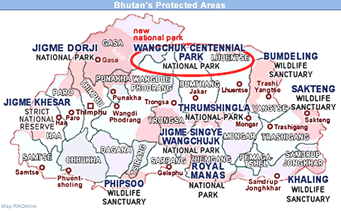
are nine protected areas in the country covering 17 dzongkhags and consists
of four national parks, four wildlife sanctuaries and one strict nature
reserve. Out of these nine protected areas, currently only six are operational.
The remaining three
areas of Phibsoo Wildlife Sanctuary, Khaling Wildlife Sanctuary and
Jigme Khesar Strict Nature Reserve (former Toorsa Strict Nature Reserve) are yet to be operationalised.
top
|
Jigme
Dorji National Park
|
 |
 |
| Jigme
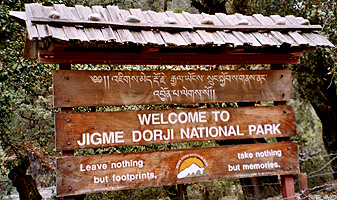
Dorji National Park with an area of 4,350 sq km is the largest protected
area system in Bhutan. Jigme Dorji National Park was initially notified
as Wildlife Sanctuary in 1974 and upgraded to a national park in 1993 and
formally established with the appointment of a park manager in 1995. It
is located in the northwestern part of Bhutan and ranges from sub-tropical
forest at an elevation of 1,400m to alpine glaciers at about 7,000m. |
|
Snow
Leopard
The
park borders with Tibetan China in the north and is home to some 6,500 Layaps,
Lunaps, Geons and Gasaps. These people are mostly local tribes and have
been living in the park prior to its establishment.
The
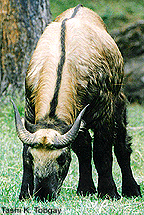
park is home to many charismatic wildlife species like snow leopard,
Bengal tigers, Himalayan black bear, common leopard, yak, blue sheep, marmot,
raven, takin, fox, wildboar, sambar, musk deer, wild dog, pika, clouded
leopard and many others found in their natural habitats. |
|
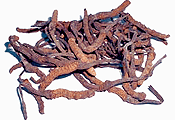 |
| Caterpillar fungus Cordyceps sinensis |
Takin |
|
 |
top
|
Jigme
Singye Wangchuck National Park
|
|
Jigme
Singye Wangchuck National Park previously known as Black Mountain National
Park was formally established as national park in 1995. The park is
located in central Bhutan and encloses an area of 1,730 sq km.
|
The
ecosystem ranges from 640m to 4,925m and has local settlement with some
6,000 people living within the park area. A local tribe called Monpa,
who specializes on cane works, is also a resident of this park. The park
has permanent ice peak like Dorshingla rising to 4,925m, alpine
lakes, pastures, conifer and broadleaf forests.
|
|
 |
Some
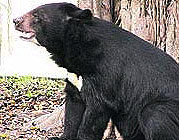
of the charismatic species in the park include red panda, golden langur which is endemic to Bhutan, common langur, sambar, musk deer, Himalayan black bear, tiger, leopard and some 449 species of birds.
Recently
a new kind of deer different from the common sambar was sighted
and identified to be the "Bhutan Shou" a species of deer, which
was believed to be non-existing in Bhutan until now. The Phobjikha valley,
which lies in the buffer zone of the park, is an important habitat of Black
Necked Cranes, one of the highly endangered birds in the world. Over 260
cranes visit this valley every winter.
|
Thrumshingla
National Park
|
|
Thrumshingla
National park lies in the east central part of Bhutan and was formally
established in 1998. The park encompasses an area of 889 sq km and covers
parts of Bumthang, Mongar, Lhuntshe and Zhemgang dzongkhags. The park is
home to some 1,000 local residents.
|
The
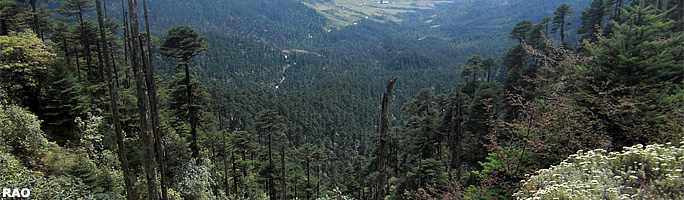
park symbolizes the highest tiger habitat at 4,000m, which is quite
rare in nature. Some of the important wildlife species include red panda,
Leopard, Himalayan black bear, tiger, musk deer, Barking deer, wild boar,
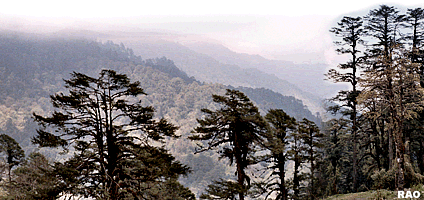
wild dog and fox. The park contains one of the richest temperate forests
in the eastern Himalayas with fir forests as old as
400
years old which form contiguous habitat for tiger distribution in Bhutan.
This
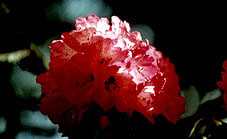
park is also the place where 22 species of rhododendrons are growing
in their natural habitat, now protected as the "Rhododendron Garden"
established in 2002 to mark the International Year of the Mountains.
|
|
|
|
Royal
Manas National Park
|
|
Located
in the south central part of Bhutan, Royal Manas National Park has
an area of 1023 sq km. RMNP is the oldest protected area system in Bhutan,
established as early as 1966 and upgraded as national park in 1993.
The
park covers three dzongkhags of Zhemgang, Sarpang and Samdrup Jongkhar with about 5000 local residents living in the park.
It
is strategically located with Jigme Singye Wangchuk National Park in the
north and India's Manas Wildlife Reserve, a UNESCO world heritage
site in the south and thus form an integral part of the protected areas
complex. |
|
 |
The
park includes a range of habitats from lowland tropical systems to the
permanent ice fields harboring a diversity of flora and fauna.Besides,
serving as the southern most subtropical Himalayan habitat for various
species of flora and fauna, it is also the extended habitat for the endangered
mega-herbivores with the like Rhinoceros, gaur, wild buffalo and elephant.
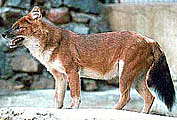
Cats like Bengal tiger, leopard, clouded leopard, marble cat also roam in this park. Others such as wild boars, wild dog, barking deer, pygmy
hog, hornbill and peacock are not a surprise. The bird species is
extremely rich with a record of over 362 species.
|
| Courtesy Ministry
of Agriculture - DOF Nature Conservation Division |
|
New
national park launched: Wangchuck Centennial Park
|
|
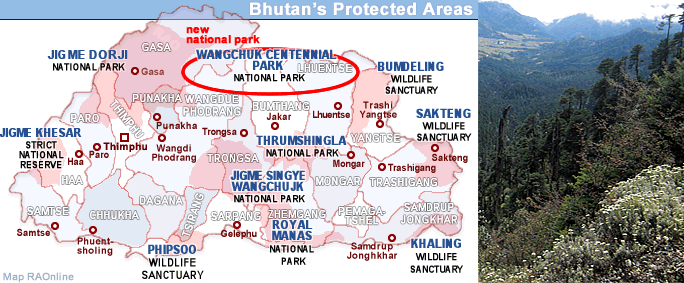
The Wangchuck
Centennial Park is covering areas of 3,736 km2 transcending over four
districts of Gasa, Trongsa, Bumthang and Lhuentse. The park will connect
the Jigme Dorji Wangchuck National Park in the northwest to Bumdeling
Wildlife Sanctuary in the east. The Wangchuck Centennial Park is the
second largest park in Bhutan. The new park in northern Bhutan has been
declared as a new national park by the Royal Government of Bhutan to commemorate
the centenary celebration of the country's Monarchy. With altitudinal range
of 2,000m to 7,200m above sea level, it conprises of significant conifer
broadleaf forests and alpine scrubs. A team of experts from the the Department
of Forests, Ministry of Agriculture has already initiated the preliminary
survey of the park.
The
new park will increase the protected areas system of Bhutan to 49.22% from
36%. On the 12th of December, 2008, the WCP was launched at Nasiphel village,
Bumthang, by the Honorable Prime Ministry Jigme Y Thinley.
|
| Source:
WWF Bhutan , January 2009
|
| Toorsa Strict Nature Reserve is now «Jigme Khesar Strict Nature Reserve» |
|
In appreciation of His Majesty King Jigme Khesar Namgyel Wangchuck's commitment to environmental conservation, the Ministry of Agriculture and Forests has renamedthe «Jigme Khesar Strict Nature Reserve.»
|
| Source:
WWF Bhutan , October 2014 |
 |
|
Thrumshingla
|
top
top
| Wildlife and People in Bhutan |
|
| Information on Bhutan |
|
|