|
Bhutan's
Education |
|
|
 |
|
Green Schools
|
 |
|
Taking stock of the innovative moves towards a happy learning environment
|
 |
|
GNH Seminar
|
From classroom rules being formed in consultation with students, to adding to a school's budget through selling waste collected through student cleaning campaigns, the education sector is in the midst of a major reform.
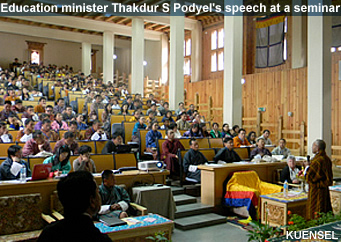
This became apparent at a seminar in Paro, where principals, teachers, lecturers and even a student spoke about their efforts and experiences in trying to implement Gross National Happiness GNH in their schools yesterday.
 |
|
Entitled 'Stories from the Schools and Classrooms' the seminar is focused on the results of the 'Educating for GNH' program. The vision aims to create teachers, who understand GNH, and who will then establish a GNH learning environment for Bhutanese children, by 2012.
In this direction, schools have introduced various initiatives. For instance, some schools now reserve certain days for causes like being environmentally friendly. There are no vehicle days, no plastic days, and even no junk food days in some schools.
|
|
One school in Trashigang, Bartsham primary, takes its environment program even further. The school made Nu 45,000 after selling plastic acquired in cleaning campaigns. The money was used to replace blackboards with a better alternative.
Reflecting a move away from the traditional top down teacher-student model, schools are also trying to create a more equal status between teachers and students. This is done by giving students more voice, responsibilities in school administration and simply more respect.
For instance, in Ghumauney HSS, Samtse, classroom rules are formed involving students, and class captains are elected by their classmates. In Wangdicholing LSS, Bumthang, "nature club" student members have been empowered to record and report "violations" of its 'no vehicle day' by both student and teachers. Again in Ghumauney HSS, teachers present khadars to new pre-primary students, and they also make an effort to eat lunch with their students at least once a week.
A Paro college of education (PCE) lecturer, Kinzing Lhendup, emphasised the importance and effort he put into remembering the names of his students. He said that, not only is it impolite, but by not remembering a name repeatedly, it demonstrated to that particular student that the teacher did not care about the student.
Some schools are also introducing new ways to bring about awareness among students of the country's culture and traditions. Traditional sports, like archery, khuru, and degor, are finding their way into some games periods. Driglam namzha and religious clubs are also being formed in certain schools.
In Peljorling MSS, Samtse, a rule that allows students to only speak in either English or Dzongkha could be implemented in an attempt at promoting the national language. But this rule was questioned by the dean of PCE, Dorji Thinley, who said that Bhutan also had a number of other languages and dialects. He asked if the rule might not have an adverse impact on these languages, "many of which are on the verge of disappearance".
The school's principal, Sonam Gyamtsho, pointed out that students would be committed to the rule only within the school.
 |
|
Surprisingly, there were no concrete results presented on what impact mindfulness or meditation sessions were having on the learning or performance of students. Sonam Norbu, a Ghumaunay HSS teacher, said that, when his class got distracted or tired, a meditation session helped them to refocus. While he pointed out that he would not be able to provide a concrete result, he said that he had conducted a survey on students that practice mindfulness and those that do not. He said that he noticed some improvement in performance.
|
|
Concerns were raised on whether students are being "burdened" with work, such as cleaning campaigns, "in the name of GNH". A participant said that GNH implementation in schools should not be only about working.
Some other GNH initiatives being introduced by schools include increasing parent participation, community service, and also in-house assistance for financially disadvantaged students.
Speaking at the opening of the seminar, education minister Thakur S Powdyel said that, while some schools are doing a "wonderful job" at becoming GNH or "green" schools, some schools have "no idea even now what GNH is and what green schools are." Lyonpo added, "I'm very worried about certain things, which are happening in the name of green schools." Lyonpo did not expound on his concerns.
"I'm delighted that a lot of schools have taken this very well and, seriously, they've gone far beyond, but many schools aren't changing and we have to make sure every school succeeds, we have to make sure every child succeeds, we have to make sure this country succeeds," he said.
| Contributed
by Kinga Demafor KUENSEL, Bhutan's national newspaper, 2011 |
|
|
Nature and Environment in Bhutan
|
|
|
|
Tourism in Bhutan
|
|
|
top
|
Links |
|
|
 |
|
External
links |
|




 Gross National Happiness (GNH) - a guiding philosophy