|
Bhutan Education |
|
|
Bhutan Education |
|
|
 |
|
Girls
are closing the gap
|
 |
When
Bhutan signed the Millennium Declaration in 2000, it was a commitment to
eliminate gender parity in primary education by 2005.
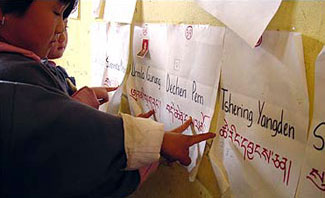 |
| Learning Dzongkha takes more time than English at the initial stage |
Girls
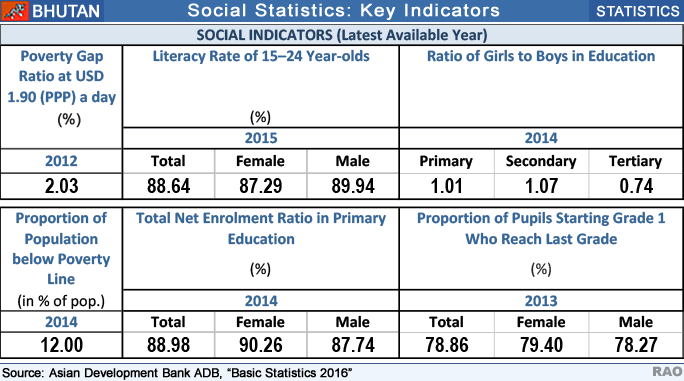
enrolment in primary education is higher than the boys enrolment.
Three
years later, Bhutan has progressed fast and could achieve Education For
All, while 70 countries are not expected to meet the goal by 2005.
|
|
The
gender parity gap in primary education has reduced from about 7 percent
in 2000 to about 2 percent this year. Of the current primary enrolment
48 percent are girls and 52 percent boys (general statistics book 2003).
In 2000, there were 45,846 boys and 39,251 girls enrolled in the primary
level (from pre-primary to class VI). In 2003, there are only about 3,868
more boys in the primary level enrolment compared to 6,945 more boys in
2000.
top
|
Girls'
enrolment |
 |
According
to a spokesman for the education ministry, the gap had been closing because
schools were reaching nearer to communities and the quality of education
was improving. "Gender is not an issue in education anymore," he said.
"The achievement was made without any specific programmes targeting girls,
this was automatically achieved when schools came closer to communities,"
he added.
"Given
the gender population parity, the 48 and 52 percent is quite an equity
already."
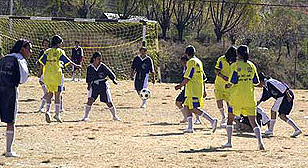 |
| With an annual average growth rate of 6.86 percent, girls enrolment
in the primary level showed a significantly higher rate compared with the
boys average rate of 4.65 percent.
Against
the common belief that girls in the rural areas are likely to leave school
even before completing primary level, a study conducted by the education
ministry revealed that school "drop-outs" were fewer among girls once enrolled. |
|
"Instead,
it revealed that it is likely for boys to leave schools," Tenzin Choeda
said. The percentage of girls to boys at the lower secondary level (class
VII and VIII) is even higher at 48.97 percent. "While the parity in the
higher classes is just a matter of time, we are also confident that gender
parity is not an issue even at the lower secondary level."
 |
| Against
the common belief that girls in the rural areas are likely to leave school
even before completing primary level, a study conducted by the education
ministry revealed that school "drop-outs" were fewer among girls once enrolled.
"Instead,
it revealed that it is likely for boys to leave schools," Tenzin Choeda
said. The percentage of girls to boys at the lower secondary level (class
VII and VIII) is even higher at 48.97 percent. |
|
Education's
general statistics, 2003, stated that female enrolment was nearing the
male enrolment at all levels except at the higher secondary level. At the
tertiary level, male enrolment is twice more than the female.
 |
| However,
according to the report, there is an impressive average growth rate for
female at the degree level at 20.7 percent.
A
report prepared by UNICEF, the only partner investing in the expansion
of primary and community schools identifies, the distance from schools,
political instability in the south, and gender stereotypes as some of the
obstacles to eliminate gender parity.
Primary
education in Bhutan is provided through 188 community, 90 primary and 13
private schools. |
|
Another 74 lower secondary, 10 middle secondary, and one
higher secondary school also have primary level classes.
| Contributed
by KUENSEL, Bhutan's National Newspaper |
|
top
| more information on Bhutan |
|
| Focus on Bhutan's Education System |
|
| Links |
|
 |
|
External
links |
 |
Bhutan
Youth
Development Fund
Y.D.F. |
|