|
Thimphu's
growth raises environmental concerns
|
 |
Bhutan's
Development |
|
|
Bhutan
Information |
|
|
 |
|
Thimphu
: Improper growth ?
|
Improper
growth, congestion, lack of parking space and bad state of sanitation-some
of the problems that metropolis grapple with-have begun to rear their ugly
heads in Bhutan, most notably in its capital city, Thimphu. According
to the Thimphu thrompon, Phuntsho Wangdi, shortage of parking areas and
congested traffic are some of the problems begging immediate attention.
Then there are the concrete structures which are not always built according
to plans and have begun to dominate whatever little available space.
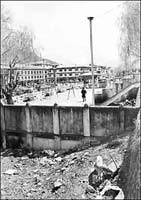 |
Thimphu
city has grown without a real comprehensive plan," said the thrompon, pointing
out that the developments in the city have far out-paced the response the
municipal body could provide. One of the mandates that the City Corporation
had been asked to fulfill when it became an autonomous body in February,
1995, was to maintain proper sanitation and the aesthetic beauty of the
town. It was felt, at that time, that the direct involvement of the residents
and the autonomy given to the newly established town committee would ensure
that the responsibilities in administering, maintaining and developing
Thimphu would reach a standard which would make all Bhutanese proud of
their nation's capital. |
Bncroached on the private lands.
The past planners might not have been far-sighted; the new constructions
in the already congested areas are symbolic of their shortcomings. With
the increase in the number of vehicles, the problem today has aggravated.
The area behind the Norzin Lam, locally known as the Hong Kong market,
is one such place needing prompt attention. The road is small, narrow and
crammed with vehicles.
top
| The
City Corporation initiated several projects |
Despite
these hurdles, the City Corporation has initiated several projects aimed
at improving the city by seeking loans from the Asian Development Bank.
A parking area is being developed at the milk booth area while the redevelopment
of Changlam and the taxi parking areas had been completed. The latter has
a two-way lane with a divider separating the parking, which can accommodate
28 cars, 43 taxis and five buses, and the carriage way. The construction
of a link road along this stretch of road is expected to ease the traffic
congestion along the Norzin Lam. Also in the plan is the construction of
an additional parking along this road.
To
encourage the use of the river side the City Corporation has begun the
construction of what it calls the walk-way riverside. Scheduled to complete
by the end of June, through the use of the walk-way, the City Corporation
aims to increase environmental awareness of the public in keeping the city
clean.
top
The
City Corporation also begins this month the development of the Clock Tower
Square which it claims will be the 'heart of the city'. The Square will
serve as a civic center offering, among others, a venue for public awareness
campaigns and cultural shows. According to a Thimphu resident, the development
of the Clock Tower Square could not be more timely. "I hope it will be
a place where everyone can come and relax and not be littered with beer
cans and popcorn packets."
The problem of garbage has absorbed a
great deal of the City Corporation's efforts and resources but a permanent
solution is yet to be found. Rinzin Namgyel, Head of Environment Division
at the City Corporation, laments the lack of progress while the thrompon
threatens to implement the "carrot and stick" rule so that anybody found
littering will be penalised. In former times, the ecological cycle
attended to whatever people churned out. Garbage largely constituted edibles
which were consumed by dogs, cats and birds, leaving no traces. With the
advent of plastics, rubber, metal, glass and chemicals which are not edible
nor biodegradable, the problem has left people anxious for solutions.
Left
unattended, today's garbage can be more than just the rotten stench and
the eye sore. Thimphu generates about 12 tonnes of garbage everyday.
In what it calls the solid wastage management, the City Corporation has
various initiatives up its sleeve. The door-to-door collection will be
increased and dust bins provided to the households at a nominal charge.
Two compacter trucks, funded by the DANIDA and the royal government at
a cost of Nu 2.6 million each, will be bought this year to reduce the number
of journeys to the landfill.
The City Corporation dumps the garbage in
Meme-Lakha on the way to Wangdue highway, 12 kilometres from Thimphu.
This move, said Rinzin Namgyel, will gradually remove the concrete bins.
An over-stuffed concrete bin with stray dogs foraging about it has become
symbolic of the garbage situation in Thimphu, particularly the town.
Meanwhile the educated lot can better themselves and the city by educating
their children about civic sense and not blatantly throw 'doma'-stained
papers and plastics on the streets. The so called "modern people" are quick
to distance themselves from the ugly heap but they couldn't care less if
distancing themselves means throwing an empty cigarette case out of their
car.
| "If
the capital town of Thimphu, with its importance, infrastructure, and concentration
of educated people cannot be kept 'clean and green', it would be unreasonable
to expect other towns to do so. These words, spoken by Her Royal Highness
Ashi Sonam Choden Wangchuck during the Keep Thimphu Clean and Green
workshop in 1992, are yet be valued. |
| Contributed
by Kinga Dema for KUENSEL, Bhutan's national newspaper, 2003 |
 |
| more
information |
 |
|









