|
Nepal's
Religious Festivals |
|
 |
| Nepal's
Religious Festivals |
|
| Bala
Chaturdashi |
 |
Pilgrims
from ail over Nepal throng at Pashupati temple from the night before and
burn an oil lamp to the god for the whole night. In the morrow they take
a holy dip in the sacred water of the Bagmati, pay obeisance to Pashupati
and traverse the route prescribed for that occasion scattering 'a hundred
variety of seeds' in Kailash forest of Pashupati so that thier dead relations
may reap the fruit of this merit in the next world.
| Buddha
Jayanti |
|
Buddha
Jayanti is a great day for the Nepalese. This day which falls on the full
moon of the month of Baisakh is celebrated to commemorate the birth, attainment
of enlightement and the death of Gautama Buddha, the founder preacher of
Buddhism, more than 2500 Years ago. It is a thrice blessed day. It is the
day when Buddha was born, when he was enlightened and when he got Nirvana
(Salvation).
Prayers
are sung and worship is offered by the devotees in leading Buddhist shrines
throughout the country including Lumbini in the Rupandehi district, which
is the birth place of Lord Buddha, the Light of Asia.
There
is a great fair held at Lumbini on this day.
| Chaite
Dashain |
|
Dashain
is a great festival of Nepalese people. In Nepal it is observed twice a
year-once in the month of Chaitra and once in Ashwin (Sept-Oct). The former
is observed on the eighth of the bright half of the month of Chaitra. On
this occasion goddess Bhagawati is worshipped and animal sacrifices are
made to her. But this festival is not observed with so much pomp and grandeur
as the one which is observed in autumn.
| Chhat |
|
The
great festival of the Mithilanchal, Chhath is being observed at the fourth
day of the lunar calendar in October. The festival bears a great significance
on increasing the faith of the mankind on truth and non-violence as well
as sympathy to all the living beings.
The
Chhath festival in which the sun is worshipped when it rises and sets.
This festival is observed for four days.
The
first day is Arba Arbain or Nahan Khan. The devotees take fast by discarding
meat, garlic and onion.
The
second day is Kharana meaning the reduction of sin.
On
the third day, the devotees go to the rivers and ponds singing folk and
devotional songs.
The
fourth day is called Paran or Parwan.
There
is a tradition of listening to Surya Puran after the conclusion of Arghya
or offering of curd, the devotees listen to the stories of the Chhath fasting.
They also listen to a story of a greedy mother-in-law and her daughter-in-law.
According
to Mahabharat scriptures, the Pandavas and Draupadi had also observed the
fast with sun worship for the successful completion of their exile.
| Dashain |
|
It
is truly the national festival of Nepal celebrated between September to
October. Every Nepali is stirred by the prospects of the joy this festival
is supposed to bring with it. The change of mood is also induced psychologically
by the turn off autumn season after blue sky and a green carpet of fields.
The
climate is also put ideal at this time, it neither being too cold nor too
warm. The Nepalese cherish their Dashain as a time for eating well and
dressing well. The whole festival lasts a total of ten days.
The
first nine days are devoted to worship the goddess Durga Bhavani and her
diverse manifestations. Each house also sets up a shrine to worship the
goddess at this time. Barley seeds are planted on the first day in every
household and nurtured for nine days.
During
the nine days goddess Durga Bhavani is worshipped and offered a lot of
blood sacrifice. Buffaloes, goats and chickens are killed in thousands
at the temples, at military posts and in every household.
One
of the main centres that witnesses the animal sacrifice in a large scale
at this time is the Hanuman Dhoka Palace on the night of the eighth day
and the morning of the ninth.
On
the concluding day of the festival called the tika, the elders of the family
give tika to their junior members and to other relatives who may also come
to seek their blessing. The fresh shoots of the barley known as 'Jamara'are
also given to wear. Family feasting and feasting of guests is a common
practice at this time. On the day of Vijaya Dashami people go to Narayanhity
Royal Palace to receive tika from Their Majesties the King and the Queen.
| Gaijatra |
|
In
this festival teen-aged boys dressed up in the attire of a cow parade in
the streets of the town. This custom spring from the belief that cows help
the members of the family, who have died within that year, to travel to
heaven smoothly. Some are also dressed up as an ascetic or a fool for achieving
the same objective to their dead family members.
Groups
of mimics improvise short satirical enactments on the current sociopolitical
scenes of the town to the entertainment of the public.
The
week beginning from Janai Poornima actually unfolds a season of good many
religious and cultural activities. All the Buddhist monasteries open their
gates to the visitors to view their bronze sculptures and collection of
painting for a week. At Patan, one observes the festival of Mataya at this
time.
The
festivity of Gaijatra itself lasts for a week enlivened by the performance
of dance and drama in the different localities of the town. The spirit
of the old festival is being increasingly adapted by Cultural Centres,
newspapers and magazines of fling humour and satire on the Nepalese social
and political life.
| Ghanta
Karna |
|
Ghanta
Karna is also known as 'Gathyamuga'. This festival is a relic of the be!ief
in demonolatry by the people of the Valley. Ghanta Karna, a demon and other
evil spirits are propitiated and exercised on this day. An effigy made
of green reeds is erected at all the main cross-roads of the town in the
day. A person is painted in all kinds of colour till he looks like a grotesque
figure representing the demon Ghanta Karna. This symbolic demon goes begging
in the locality.
At
the end of the day he is dragged to a river on the green reeds symbolising
the driving away of the demon from the locality.
| Naag
Panchami |
|
This
is devoted to the worship of the Nagas, the divine serpents. Pictures of
the Naga are stuck over the doorposts of all the houses in the morning
as protective spells. This is also the day for the beginning of Gunialakhe
dance in Kathmandu in which persons wearing masks of a demon entertain
the people with their gimmick.
| Ghode
Jatra |
|
Ghodejatra
or the festival of horse is held on-the fourteenth of the dark half of
the Chaitra (sometime in March or April). The festival has two sides of
its celebration. Its cultural side involves the Newars of Kathmandu who
celebrate it for several days. The idols of the gods of many localities
are taken in a procession in their area in portable chariots. Every household
is feasting at this time. A demon called 'Gurumumpa'is also propitiated
at this time in Tundikhel.
This
festival is called Pasachare. The other aspect of the festival is provided
by the function organised by the Royal Nepalese Army at Tundikhel in the
afternoon of the main day. Horse race and acrobatic shows are presented
at this time in which His Majesty the King is present. A meeting of lumadi,
Bhadrakali, Kankeshwari and Bhairav takes place during the day time at
the main celebration at Ason. The deities are brought in their portable
chariots. The same festival is repeated at night in Tundikhel.
| Gokarna
Aunsi - Father's Day |
|
This
day is observed as the Father's Day with the expression of proper regards
towards one's father. It is individually performed by persons out of filial
piety. Those whose fathers are already dead go to bathe and perform shraddha
ceremony in honour of their dead fathers at Gokarna. The fortunate ones
whose fathers are alive present him with gifts of sweetmeat and delectable
food and drink and receive blessings in return from them. Government offices
are closed on this day.
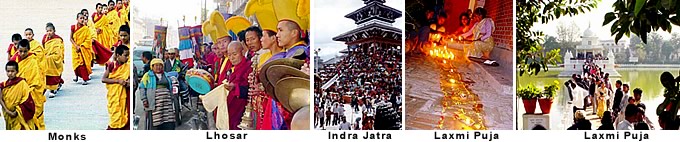
| Indrajatra |
|
Like
Gaijatra it also heralds a week of religious and cultural festivity in
Kathmandu. There are several foci of this festival.
On
the night when this festival begins, members of the family in which death
has taken place within one year go round the town limits of Kathmandu burning
incense and putting lamps along the route. The same morning a tall wooden
pole representing the standard of lndra, the king of gods is erected in
front of the Hanuman Dhoka Palace. Wooden statutes of lndra and large wooden
masks of Bhairav are put on display in the old bazaar. Several groups of
religious dance like the Devinach, Majipat Lakhe, Bhairav and Bhakku and
Mahakaii Nach come into life during this week.
The
week also commences the dragging of chariots of Ganesh, Bhairav and Living
Goddess Kumari in Kathmandu. His Majesty the King comes to pay homage to
Kumari just before the start of the chariot-pulling.
| Janai
Poornima (Janai Purnima) |
|
This
festival is also known as Rakshya Bandhan. The full-moon of the month of
Shrawan, the day when this festival is observed, is considered sacred ail
over Nepal and is celebrated in different manner by different groups of
people of Nepal. However, the most widely accepted mode of celebration
is that on this day people take a ritual bath and change their sacred thread.
Everyone
gets a string of thread tied in his wrist from the Brahmans as a protective
mark for the whole year. The Nepalese prepare a special dish called 'Kwati,
(mixed sprouted beans) on this day. This day is also held sacred for bathing
in Gosainkunda.
One
can also see a pageantry of the Jhankris (witch doctors) attired in their
traditional costume come to bathe at Kumbheshwor at Patan. These Jhankris
also visit the temple of Kaiinchowk Bhagavati (the goddess at Kalinchowk)
in Dolkha district where they go to beg for their healing powers, as they
are the traditional healers of the Nepalese villagers.
On
the occasion, 'Tagadhari Hindus' change the Janai or the sacred thread
today after having a haircut and holy dips in ponds and rivers. People
also receive the 'Rakshya Bandhan' thread around their wrist from a Brahmin
priest.
The
'Rakshya Bandhan' thread is purified by mantras from Vedas and is regarded
a symbol of protection, according to Hindu belief.
The
Newar community observe the festival as 'Gunhu Punhi' while Gurung and
Thakali community observe Yatung mela (fair) in the premises of Mukninath
temple in Mustang on this day. During the fair, exhibition of local goods
and horse races are performed.
On
the occasion, people consume 'Kwati'- a soup prepared from nine different
beans. In the Terai, sisters tie Rakhis to their brother's wrist wishing
them a long and prosperous life.
| Lhosar |
|
The
Tamang community across the country and abroad are celebrating the Lhosar
festival with much fanfare. The festival is celebrated as their New Year.
This festival is observed in Nepal by the Tamang, Sherpa, Gurung, Magar,
Thakali, Jirel, Nesyangba, Bhote, Dura and Lepcha communities. However,
these communities observe the festival on different dates under different
names like Tola Lhosar, Sonam Lhosar and Gyalpo Lhosar.
|