|
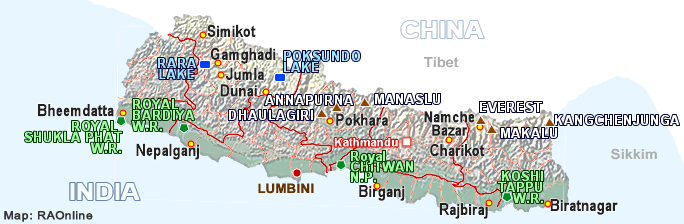
Nepal Geology |
|
|
 |
| Nepal's
Foot Hills (Foot hill zone) |
 |
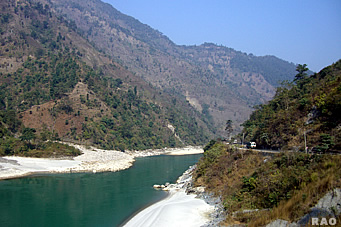 |
 Trisuli-River Trisuli-River
The
Sub-Himalayas is the youngest range of the whole Himalayas. Its origin
is directly related with the elevation of the Tibetan-Tethys Himalayas,
Higher Himalayas and Lesser Himalayas.
The
sediments of the Siwaliks was deposited in the foredeep basin just in front
of the rising mountain chain. The evolution of the Himalayas started when
the Indian plate collided with the Eurasian plate. The actual upliftment
of the Himalayas began about 38M a ago. |
|
| Siwalik |
 |
It
is commonly used for molasses type Neogene's sediments of Himalayan
foot hill zone. The age range as indicated by mammalians fossils from
middle Miocene to early Pliocene.
In
Nepal the Siwalik system form 20-30 km Foot Hill belt sand extend south
into the subsurface of the genetics plain these terrestrial largely fluviatile
deposits reach over 5 km in thickness.
The
Sub Himalayan Zone or the Siwaliks of Nepal extends throughout the country
from east to west in the southern part. It is delineated by the Himalayan
Frontal Thrust (HFT) and Main Boundary Thrust (MBT) in south and north
respectively. The Siwaliks consist of very thick (4,000 to 6,000m) molasses-like
fluvial sedimentary deposits comprising a coarsening-upwards sequence as
a whole, which reflects the rising history of the Himalayas.
The
name Siwalik was introduced for the Sub Himalayan rocks by Medlikott
in 1864, and this term is derived from the Siwalik Hills in Deharadun
(India). It is commonly used for the molasse-type Neogene sediments
of the Himalayan Foot Hill zone. The age range, as indicated by the
mammalian fossils, is from Middle Miocene to Early Pleistocene.
top
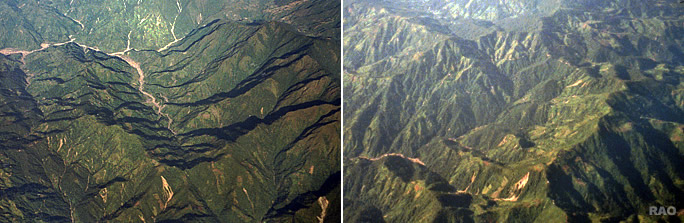
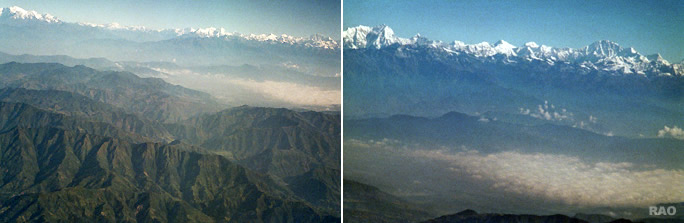
| Terai,
the Siwaliks and the Middle Mountains |
|
 |
|
South
of Kathmandu |
 |
|
Under
a layer of fog: Kathmandu Valley |
|