|
Nepal SOCIAL LIFE |
|
|
Nepal Information |
|
|
 |
|
Poor
maternity care poses threat to women |
 |
KATHMANDU,
3 Aug 2006 (IRIN)
Concerns
are growing about the poor level of maternity care for Nepalese women.
"Despite
decades of efforts to improve the reproductive health situation,
thousands of Nepalese women still die while giving birth," said Mahendra
Bista, director general of the government's Department of Health (DOH)
in the capital, Kathmandu.
The
Ministry of Health said just 13 percent of deliveries were attended by
skilled birth attendants in rural areas and there was a severe lack of
emergency obstetric care.
Around
6,000 women in the impoverished Himalayan kingdom die every year due to
pregnancy-related complications, according to the United Nations Fund for
Population Agency (UNFPA). Nepal has one of the world's highest maternal
mortality rates (MMR) of 740 per 100,000 births.
"Reproductive
health is not just the Nepalese women's concern but is a major development
issue," said Safieh Anderson, UNFPA's deputy representative.
 |
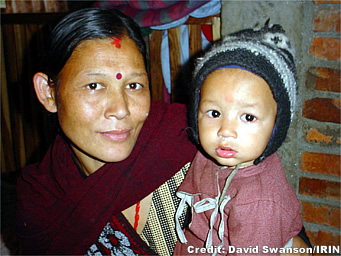
| Most women are not as lucky as Shanta Karki
The
UN agency has organised several reproductive health camps and provided
help to women in rural areas during Nepal's armed conflict.
The
lack of basic health care in rural areas, where 80 percent of the population
lives, has been exacerbated by the decade-long conflict between Maoist
rebels and the Nepalese state. As a consequence, maternal illnesses
- which are estimated to grow by 100,000 new cases every year - remain
unattended, UNFPA experts said. |
|
Since
April, the Maoists have been involved in a peace process with the interim
government formed by the country's seven national parties after protests
ended King Gyanendra's direct rule.
Nepalese
health professionals have urged the government to start prioritising maternity
care by expanding safe motherhood programmes around the country before
the peace process is completed.
Supported
by the European Commission (EC), UNFPA recently launched a one-year project
to organise mobile reproductive health camps in six hill and mountain districts
in west Nepal.
 |
| It
aims to provide diagnosis, counselling, treatment and vital surgery for
prolapsed uterus correction cases.
However,
reproductive health activists claim that the government and the national
media have ignored the issue.
"You
find that a large number of Nepalese women in the rural areas are not even
aware of the basic knowledge on safe motherhood practices," said Urmila
Aryal, the minister for Women, Children and Social Welfare. Women
from the poorest households suffered the most due to their low income,
as they could not afford to travel to urban areas to get emergency treatment,
she said. |
|
"There
is a crucial need to strengthen our health services. No matter how effective
[the] programmes we introduce [are], they will not last until we have a
good health service and enough skilled health providers in place," Aryal
said.
Source: IRIN 2006
Copyright
Ⓒ UN Office for the Coordination of Humanitarian Affairs 2007
[
This report does not necessarily reflect the views of the United Nations]
Integrated
Regional Information Networks (IRIN), part of the UN Office for the Coordination
of Humanitarian Affairs (OCHA). |
 |
| more information |
|
 |
|
Externe
Links |
|