 |
| Social Status of Women |
|
 |
 |


 |
 |
| The hidden costs of early marriage |
|
KATHMANDU, 15 May 2012 (IRIN)
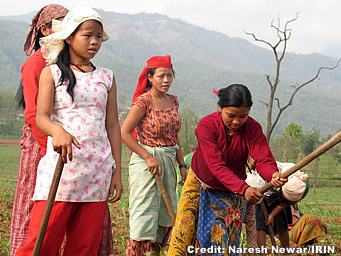
Girls education is already a challenge in Nepal
 |
|
Over 34 percent of new marriages in the Himalayan nation involve brides under 15 years of age despite a ban on the practice, according to the Ministry of Women, Children and Social Welfare.
NGOs say the government has failed to control child marriage, particularly in the country's southern Terai region. In some districts in eastern Terai, like Rupendehi, Dhanusha and Mahottari, more than 50 percent of marriages involve girls under the age of 12. "We recently heard that a five-year-old girl was married," Helen Sherpa, an education specialist with World Education, an international NGO, told IRIN.
Dowry challenge
Dowries are a major concern. If the girl is particularly young, nuptials between the families are routinely undertaken in secret because a lower dowry is paid.
"The younger the bride is, the cheaper the dowry," Sherpa said. Many impoverished families in the Terai region often have no choice but to pay a higher dowry for an older girl to marry their son. Prices range from US$200 to $20,000, depending on the age of the bride, and can be prohibitively expensive if she is a qualified teacher, engineer or doctor.
Although the number of child marriages seems to have stayed constant in the past decade, some changes are taking place. Daughters are now sent to the husband's family only when they reach the age of 16, but the question remains as to whether they can still attend school after they marry.
"My daughter was 12 and now she is 17, and old enough to go her husband's family," said a woman who asked not to be identified. She was aware that child marriage and the dowry system are now illegal in Nepal, but said such arrangements between families continued in Mahottari District, 300km east of the capital, Kathmandu, where a high number of child marriages still take place.
Risking their future
"Early marriage should be stopped because it not only affects their [daughter's] education but also their health," said Sumon Tuladhar, an education specialist at the UN Children's Agency (UNICEF). "In addition, that also has an impact on their self-confidence and empowerment. Many children are victims of early marriage - after marriage they hardly come to school, and even if they do, their performance is very poor."
Getting girls to stay in school is not always easy
According to the UN, Nepal has achieved gender parity of about 0.99 percent in primary education enrolment, but even government officials are sceptical about the number.
"Gender parity in education is only limited to enrolment, not retention, continuance and performance," Dawadi said. The government realized it needed to do more about getting girls back into the classroom, she noted, but it should also work on ways to eliminate discrepancies in the quality of their education.
More than 240,000 children do not attend school according to government figures, and officials believe most of them are girls, especially those who were married at a young age.
"Child marriage changes the children's life options, especially their educational investment by parents," said Sherpa. "As soon as she becomes someone else's "property", the parents show little willingness to invest in their education as they grow. This is total abuse of their rights."
Public school fees are more affordable at the primary level but the higher grades are often beyond the reach of parents. Nepal's literacy rate for its population aged 6 to 15 years is 60.9 percent, of which 72 percent are boys, but only 51 percent are girls.
The literacy rate declines as children get older and the discrepancy is wider - among those aged 15 and above literacy is at 56.5 percent, with around 71.6 percent being young men but only 44.5 percent being young women, according to the government's Central Bureau for Statistics.
Some experts believe that the only way to stop early marriage is to prosecute the families. "Prevention is important because once the marriage has happened, it is difficult to change that," said Sherpa. Putting a mother in jail is not helpful when she has children at home, but the crime will not go away if such steps are not taken, she added.
A recent report by Plan UK, an international charity, notes that globally some 10 million girls under the age of 18 marry each year.
|
| Source:IRIN 2012 Copyright Ⓒ UN Office for the Coordination of Humanitarian Affairs 2012 [ This report does not necessarily reflect the views of the United Nations] Integrated Regional Information Networks (IRIN), part of the UN Office for the Coordination of Humanitarian Affairs (OCHA). |
 |
|
 |
| When early marriage, leads woman to prostitution |
|
A 26-year-old divorcee from Kavre, who always regrets her marriage at an early age. Her parents married her off to a much older manwhen she was just 16. After going through a traumatic experience with her husband, Shilu decided to take the boldest decision in her life- to leave her husband. With no other option left in the village, Shilu came down to the capital looking for better future.
This class 11 student managed to bag the job. As she was living here alone, she happened to meet a 60-year-old man living in her neighbourhood. This old man immediately impressed this lonely girl whom she call a grandfather and the latter too gave her the care she was looking for. But her relation with this old man turned into a nightmare when he forced her to marry another old guy called. "He lured me to get married telling me that many rich girls and even a film heroine had approached him for marriage," recalls Shilu. But after 6 months of marriage, her second husband left her again. She met same situation again.
The man whom she regarded as her godfather had actually sold her to Mahoto for six months. When a matured, once married and a working woman like Shilu can make such mistakes, what can be in store for thousands who are illiterate and innocent. Education, they say is the solution to all the problems. But in her case, education didn't help much. It is poverty and rigid social structures that forced her into oblivion.
Though many Nepalese women still regard marriage as the ultimate goal of their lives, thousands of them have experienced it as the sheer nightmare. Ironically, marriage has been one of the easiest options for the brokers to lure village women into prostitution. A majority of village girls get attracted to the brokers' made-upprofile as they always aspire for better living in the cities.
But they ultimately land up in prostitution, most of them taken to the brothels in neighbouring Indian States. Social activists experienced this fact during their research in the eastern Terai districts. They found out about a gang that consisted of a group of good-looking men who lure village girls into marriage and then sell them off at the border. It is a bitter truth that social status of a woman can be attained only if one is married.
Girls from the rural areas feel secured only after getting married and depend totally onthe husband's earnings. But today, marriage the holy institution has unknowingly an easy trap for receiving women into trafficking and prostitution.
A Police inspector at the Women and Children Unit in Jawalakhel says that many girls come to the capital to earn money and in course of time, they always feel that marriage would give them security and social status. "Thus many are easily trafficked."
According to a research on the psycho-social impacts on violence against women and girls, conducted by Saathi in five districts, some of the women get married at the young age while 70 per cent of them get married at the age of 19. Only 26 per cent were married in their early or late 20s and some 3 per cent when they were older.
The research has also mentioned the outcome of UNICEF study in 1998, which says that 79.4 per cent girls get married by the age of 18 years. Parents' marrying off theirdaughters at the young age is one of the main causes for the girls being dragged into prostitution, as they do not know what marriage is all about.
A social activist says, "Marriage is still the be all and end all status in our society and it's now high time the society has to break it's rigid norms of giving a sense of identity onlyto married women and building barriers for the unmarried ones."
| more information |
|
 |
|
 |
|
| Links |
|
 |
|
External Links |
 |
 |
 |
 |
|
| UNFPA | OCHA | IRIN News | |
|
 |
|
|

 |
|
 |
|

|
 |

|

|

|