 |
 |
Nepal's Religion Kumari - The Living Goddess |
|
|
| Kumari
- The living Goddess |
| Kumari |
 |
 |
| Kumari
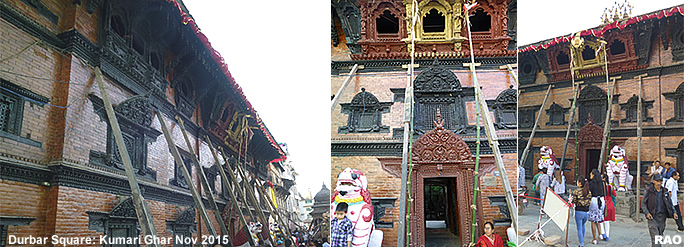
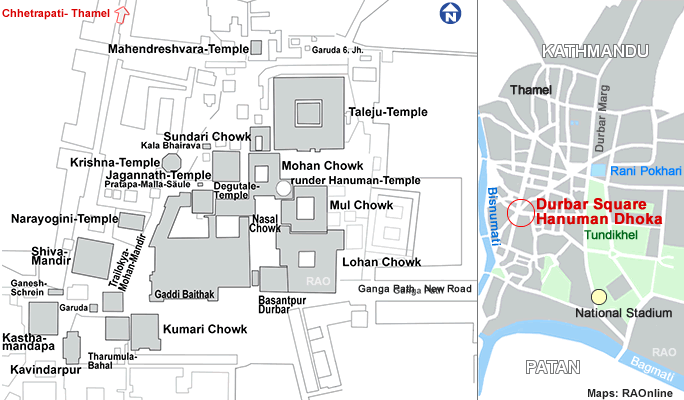
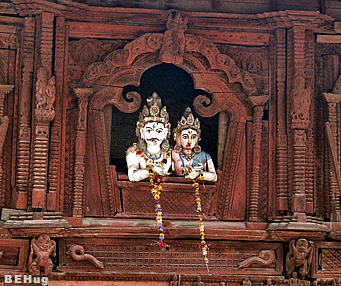
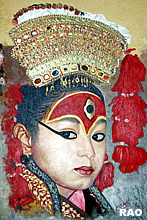
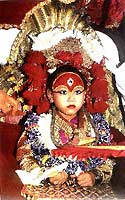
- the living Goddess. Every tourist in Kathmandu hopes to have a glimpse
of her when she appears for a short moment in a window of the palace of
Kumaru Bahal, where she lives. She's a beautiful little girl with black
hair and dark eyes. She's the innocence of a child, but at
the same time the sensuality of a woman with red painted lips and a Mona
Lisa like smile. In her forehead she wears a large tika, which is more
than a decoration. It symbolizes a third eye, with which she can see other
dimensions. |
|
 |
The
process of finding a Kumari is complicated. Little girls from a certain
cast are being selected. Great demands are made to the girl.
She
must have the body of the Banyan tree, legs like a deer, neck like a conch
and eyebrows like the cow. She must never have lost a drop of blood.
Before
she's accepted she has to go through some awful situations, to test her
nerves and courage. Kumari lives an isolated life in luxury. Her feet must
not touch the ground, and the 4 or 5 times she appears outside the palace
she's carried in a covered palanquin. The day when she has her first period,
she must leave the palace and go back to her poor family, which is difficult
after having lived in luxury. It's not easy to find a husband for her.
Men are usually afraid of her, since she's been a goddess. The rumour says
that a man who marries a Kumari will die young.
| Kumari
resumes audience to tourists |
|
January
03, 2004
Kumari,
the Virgin Living Goddess who is worshipped by millions of Nepalis
has once again started giving darshan or audience to foreigners after an
11-month hiatus at her abode-Kumari Ghar, Basantapur. Foreign
tourists were restricted from seeing the Kumari following a dispute over
allowances to be given to the Living Goddess from the fees raised from
them.
| How
to visit Kumari? - Nepali visitors and Foreigners |
Nepali
visitors ...
go
to the top floor of the Ghar to worship the Kumari. But foreigners are
allowed only in the courtyard where they can have a glimpse of the Kumari
as she looks out of her window. |
Foreigners
...
can
have a glimpse of the Kumari from 8 to 12
in the morning and from 4 to 7 in the evening everyday.
But
in the winter, it closes an hour early in the evening. |
|
As
per the new agreement, any offering of gifts or money is purely voluntary.
In the past, tourists were charged a certain amount. But taking
photographs of the Kumari is prohibited.
| Kumari
hidden for tourists' eyes |
|
September
2003
The
Kumari has stopped appearing at her palace window. The six-year-old Preeti
Sakya - the living Hindu goddess or Kumari - has been hidden away for six
months during a row over who gets tourists' money. Kumari's guardians say
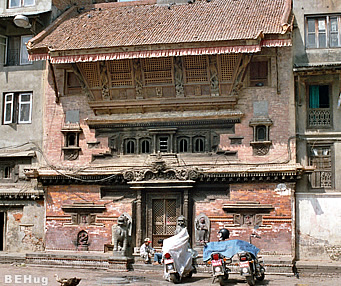
she should receive a fair share of the fee tourists pay for entry to Kathmandu's
Hanumandhoka palace square where she lives. The guardians want 10% of the
take from entrance fees. Municipal officials say they have to use the proceeds
of the $2.50 fee to maintain the world heritage-listed site. Normally,
the Kumari appears for tourists through an intricately carved window at
her residence in the historic square.
| Additional
pension for Living Goddess Kumari |
|
December
24, 2000
Kumari
or the Living Goddess has been awarded increased pension. Government will
also make arrangements for her education and livelihood. The Kumari lives
at the Kumari Ghar in the heart of the capital during her tenure and returns
home on completion of her term. For the first time, government will make
housing arrangements for Sri Ganesh and Shri Bhairav besides providing
for their education and livelihood. The new and additional facilities are
"being provided as they are an indispensable part of national culture and
in order to impart liveliness to the nation's glorious cultural and religious
traditions," the government said. The Kumari is worshipped by Hindus and
Buddhists until she reaches puberty when she is replaced. The King receives
her blessings annually during the Indrajatra
festival in the autumn.
| Kumari:
Living goddess or victim of tradition? |
|
June
2008
| Nepal's
'living goddess' in limbo |
|
| BBC Nepal's
'living goddess' in limbo June 2008 |
October
2006
| Nepal
'goddess' inquiry ordered |
|
 |
The
Supreme Court in Nepal has ordered an inquiry into whether the tradition
of worshipping a "living goddess" has led to the exploitation of girls.
The
tradition among a Hindu sect of worshipping the "goddess" - or Kumari -
in Kathmandu is centuries-old.
The
landmark order has come in response to a petition seeking an end to the
tradition, which campaigners say is a violation of human rights.
A
final ruling is due after the three-month investigation is completed.
| BBC Nepal
'goddess' inquiry ordered |
|
|
February
2007
| Kumari:
Living goddess or victim of tradition? |
|
Two
cases pending at the Supreme Court, one to reform and the other to preserve
the Kumari tradition, have set the stage for a classic battle between tradition
and modern rights notions. Under the Kumari tradition, a pre-pubescent
girl from a Buddhist Shakya family is worshipped as an incarnation of the
Hindu goddess Taleju.
Lawyer
Pun Devi Maharjan filed a case at the apex court in May 2005 demanding
protection for the rights of girls chosen as Kumaris
| KANTIPUR Kumari:
Living goddess or victim of tradition? |
|