| Nepal's
Glaciers - Climate Change |
 |
Nepal Himalayas Glaciers |
|
Nepal Information |
|
|
 |
|
Himalayan glaciers - Climate change is real and happening now.
|

|
|
|
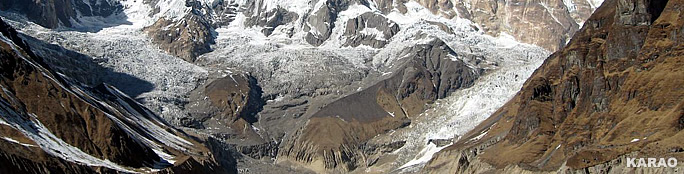
Glaciers
flowing down from Annapurna I
|
The
planet is already experiencing its impacts on biodiversity, freshwater
resources and local livelihoods. Using current climate change trends, by
2100, the average global temperature may rise by 1.4 - 5.80C according
to the Third Assessment Report from the Intergovernmental Panel on Climate
Change (IPCC, 2001). This is certain disaster for fragile ecosystems like
glaciers.
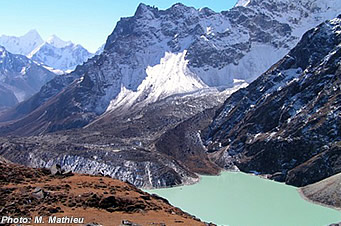 |
| Chhukung (4730 m) |
| Seventy
percent of the worlds freshwater is frozen in glaciers. Glacier melt buffers
other ecosystems against climate variability. Very often it provides the
only source of water for humans and biodiversity during dry seasons. Freshwater
is already a limited resource for much of the planet, and in the next three
decades, the population growth is likely to far exceed any potential increase
in available water. |
|
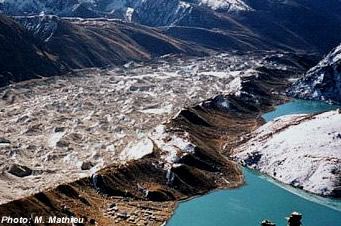
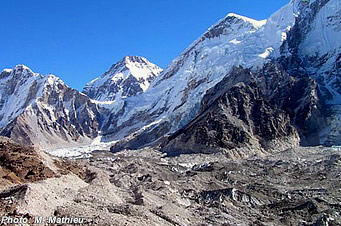
The
Himalayas have the largest concentration of glaciers outside the polar
caps.
With glacier coverage of 33,000 km2, the region is aptly called the
"Water Tower of Asia" as it provides around 8.6 x 10⁶ m3 of water annually
(Dyurgerov and Maier, 1997)
These
Himalayan glaciers feed seven of Asia's great rivers: the Ganga, Indus,
Brahmaputra, Salween, Mekong, YanGIZe and Huang Ho. It ensures a year round
water supply to millions of people.
Climate
change has impacted the glacial ecosystem tremendously. Sixty-seven percent
of glaciers are retreating at a startling rate in the Himalayas and the
major causal factor has been identified as climate change (Ageta and Kadota,
1992; Yamada et al., 1996; Fushinmi, 2000). Glacial melt will affect freshwater
flows with dramatic adverse effects on biodiversity, and people and livelihoods,
with a possible long-term implication on regional food security.
WWF
sees the impacts of climate change on glaciers and its subsequent impact
on freshwater as a major issue, not just in the national context but also
at a regional, transboundary level. The WWF offices in Nepal, India and
China are taking the initiative to develop a regional collaboration to
tackle climate change impacts in the glacial ecosystem and address adaptation
measures. This report is the outcome of a regional collaboration of the
three countries, providing an overview of climate impacts on glaciers with
a focus on key areas that needs future intervention.
We
hope this will highlight the issue of climate change and galvanize policy
makers to take action to ensure a living planet for future generations.
|
Dr
Chandra Prasad
|
Gurung
Ravi
|
Singh
Jim Harkness
|
| WWF
Nepal Program |
WWF
India |
WWF
China Program |
|
Nepal's
Glaciers
|

|
| Source:
WWF Nepal, "An Overview of Glaciers, Glacier Retreat, and Subsequent Impacts
in Nepal, India and China", 2005 |
top
|
Links
|
|
 |
|
External
link |
 |
 |
 |
 |
 |
| GRID-Arendal
News |
NASA's
Global Change Master Directory |
United
Nations Environment Programme |
World
Glacier Monitoring Service |
International
Centre for Integrated Mountain Development |
|
 |
 |
 |
 |
|