| Nepal's
Glaciers- Climate Change |
 |
Nepal Himalayas Glaciers |
|
Nepal Information |
|
|
 |
January
2009
|
2007:
Global glacier melt continues
|

|
| Glaciers
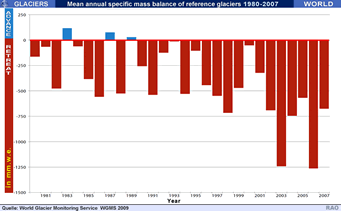
around the globe continue to melt at high rates. |
 |
Tentative
figures for the year 2007, of the World Glacier Monitoring Service at the
University of Zurich, Switzerland, indicate a further loss of average ice
thickness of roughly 0.67 meter water equivalent (m w.e.).
Some glaciers in the European Alps lost up to 2.5 m w.e.
 |
 |
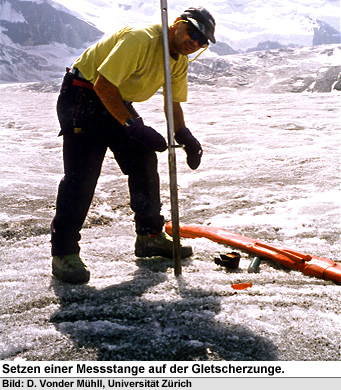
| Drilling
of an observation stake on a glacier tongue. |
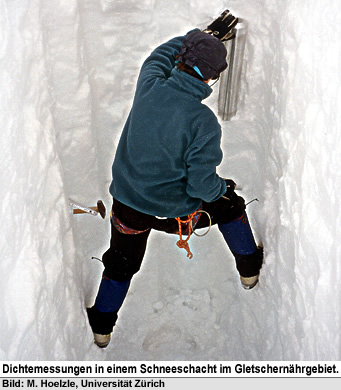
Density
measurements in a snow pit in a glacier accumulation zone. |
The
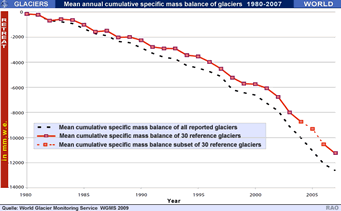
new still tentative data of more than 80 glaciers confirm the global trend
of fast ice loss since 1980. Glaciers with long-term observation series
(30 glaciers in 9 mountain ranges) have experienced a reduction in total
thickness of more than 11 m w.e. until 2007. The average annual ice loss
during 1980-1999 was roughly 0.3 m w.e. per year. Since
2000, this rate has increased to about 0.7 m w.e. per year.
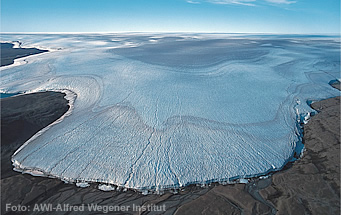 |
Glacier in Greenland (Europe)
| Michael
Zemp, glaciologist and research associate of the WGMS, said: «The
average ice loss in 2007 was not as extreme as in 2006, but there were
large differences between mountain ranges. Glaciers in the European Alps
lost up to 2.5 meters water equivalent of ice, whereas maritime glaciers
in Scandinavia were able to gain more than a meter in thickness. |
|
However,
2007 is now the sixth year of this century in which the average ice loss
of the reference glaciers has exceeded half a meter. This has resulted
in a more than doubling of the melt rates of the 1980s and 90s.»
For
the observation period 2007, dramatic ice losses were reported from glaciers
in the European Alps, such as of the Hintereisferner (-1.8 m w.e.) or the
Sonnblickkess (-2.2 m w.e.) in Austria, the Sarennes (-2.5 m w.e.) in France,
the Caresèr (-2.8 m w.e.) in Italy, or of the Silvretta (-1.3 m
w.e.) and Gries (-1.7 m w.e.) in Switzerland. In Norway, many maritime
glaciers were able to gain mass, e.g. the Nigardsbreen (+1.0 m w.e.) or
the Ålfotbreen (+1.3 m w.e.), although the glaciers further inland
have continued to shrink, e.g. the Hellstugubreen or the Gråsubreen
(both with -0.7 m w.e.).
top
All
mass balance programmes in South American reported negative values ranging
from -0.1 m
w.e.
at the Echaurren Norte in Chile to -2.2 m w.e. at the Ritacuba Negro in
Columbia. In North America some positive values were reported from the
North Cascade Mountains and the Juneau Ice Field together with a continued
ice loss from the glaciers in the Kenai Mountains and the Alaskan Range
as well as from Canada's Coast Mountains and High Arctic.
top
|
Measuring
unit 'water equivalent' |
|
Glaciologists
express the annual mass balance, i.e. the gain or loss in thickness, of
a glacier in 'meter water equivalent' (m w.e.). This standardized unit
takes the different densities of change measurements in ice, firn and snow
into account. One meter of ice thickness corresponds to about 0.9 m w.e.
|
World
Glacier Monitoring Service |
|
The
internationally coordinated glacier monitoring was initiated in 1894, following
the example of the Swiss national observation network, and has been mainly
under Swiss leadership since then. Today, the World Glacier Monitoring
Service (WGMS) is responsible for the collection and publication of standardized
glacier data from around the world. The WGMS is located at the University
of Zurich, Switzerland, and maintains a collaborative network of national
correspondents and principal investigators in the countries involved in
glacier monitoring. The long-term measurement series of glacier mass balance
produces one of the essential variables within the international climate-related
monitoring programmes.
 |
|
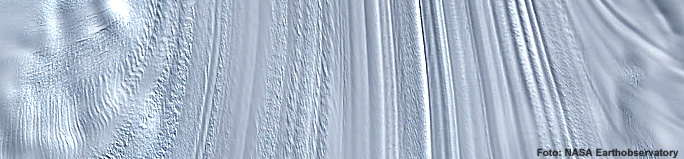
Byrd-Glacier
(Antarctica) |
top
|
Links |
|
 |
|
External
link |
|
Related
Information |
|
|