 |
Bhutan's
Festivals Tshechu |
|
Bhutan Information |
|
|
 |
|
Punakha
celebrates first tshechu in 2005
|
 |
Punakha
celebrated its first three-day tshechu in the dzong following the annual
goempoe Drupchen which concluded on February 17, 2005 with the norbu
chusani (symbolic
immersion of the Rangjung Khasarpani in the Mochu) ceremony.
| The
first day of the tshechu |
 |
The Zhabdrung
Phuensum Tshogpa thongdrel was unfurled
for public viewing from 4.30am to 9.00 am. The relics of Phajo Drugom
Shigpo were also revealed to bless devotees.
Besides
the chams performed by the central monk body and the public of Punakha,
the Royal Academy of Performing Arts and the central monk body jointly
performed a short drama depicting the life of Zhabdrung Ngawang Namgyal.
According
to Lam Kunzang of the dratshang the tshechu was initiated with a proposal
by the home and cultural affairs minister, Lyonpo Jigmi Y. Thinley, to
celebrate Punakha's historical significance.
Kuenga
Gyeltshen, 71, of Kabji said he was delighted to have the opportunity to
witness a tshechu locally. He had only observed the annual Drupchen so
far. "People often go to other places for tshechu celebrations but most
of us cannot afford to do so."
People
also participated in entertainment programmes like a tug-of-war, shot
put, sand-carrying, wood chopping, and traditional wrestling. The tshechu
will conclude with the lighting of butter lamps and prayers for the well
being of the country.
top
|
Punakha
Domchhoe in 2006: Marchang ceremony |
|
|
More
than 1000 people from Punakha and the neighbouring dzongkhags and
some tourists are attending the Domchhoe, which started on March
04 and ended on March 08, 2006.
| Marchang
ceremony |
|
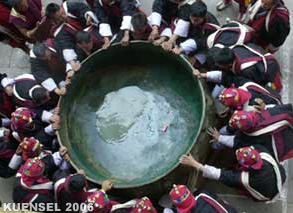 |
| Pazaps bring out a giant bowl into the courtyard of the Punakha Dzong to
perform the Marchang ceremony. |
On
the first two days of the Domchhoe, the monks performed the nfangchham, dance
ceremonies performed inside the dukhang of the dzong. It included the
zhana chham, the Black Hat dance, and other sacred dances.
The
Pazaps (traditional militia force) perform the Maachham, resonating
war songs and sounds of explosions from the third day. Firecrackers are
thrown into the courtyard of the dzong to recreate the noise of battle. |
|
The
Pazaps will perform the Lengmag dance in the presence of His
Holiness the Je Khenpo in the Dzong courtyard.
| His
Holiness, the Je Khenpo |
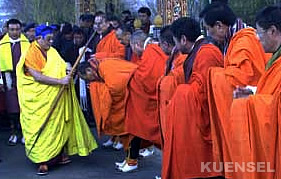
| The Domchhoe will
end with His Holiness leading the ceremonial procession for the
symbolic immersion of the precious relic, Rangjung Kharsapani, into the Mochu
River.
According
to a Dratshang spokesperson, the immersion ceremony was performed
by the Zhabdrung in 1639 to trick the Tibetan invaders into believing
that the Rangjung Kharsapani had been thrown into the river. |
|
 |
Lopen
Gyeltshen, Dratshang administration officer, said that the ritual ceremony
of the Domchhoe was to appease the protecting deity of Bhutan, Yeshey
Goenpo or Mahakala, and an expression of gratitude to all forms of
protecting deities
The
three-day Punakha tsechu, which was introduced last year, begun
on March 9, 2006.
|
| By
Kesang Dema in Punakha, KUENSEL, Bhutan's National Newspaper 2006 |
| Information on Bhutan |
|
 |
|
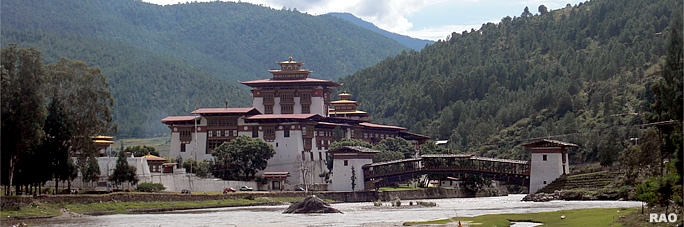
Punakha
dzong and Mo Chhu (River) |
|











