| You are here: | Home > Bhutan > Overview >Topics > Religion > Thanka > Thanka > Thuenpa Puen Zhi | Search |
 |
| Bhutan's Religion |
| Four Harmonious Brothers - Four Faithfull Friends |
|
 |




|
  |
 |
| Understanding the symbolism of Thuenpa Puen Zhi |
|
 |
|
Differences in shape, sizes, colours, and the simplicity of the painting aside, the Thunpa Puen Zhi forms one of the first and lasting impressions of Bhutanese paintings.
| The four harmonious friends |
 |
But even as the painting takes its place in most Bhutanese homes, lhakhangs and monasteries, and dzongs in the form of a wall painting or a Thanka, there are few who understand its real connotations.
While many believe that the painting symbolises harmony and unity in family or society, it has a world of meaning contrary to its commonplace perception as an obvious symbolism of harmony.
According to a Bhutanese scholar, Dasho Lam Sanga, the Puen Zhi can be traced back to various life cycles Lord Buddha attained before his enlightenment. "It is in the context of the teachings of Lord Buddha," said Dasho Lam Sanga.
"It symbolises interdependence despite the difference in size and strength of the animals. It is an epitome of friendship, cooperation, good relation without considering hierarchy, strength, power or even size. It depicts the virtues of Buddhist morals. At a single glance one will know that four different species of animals are united in harmony."
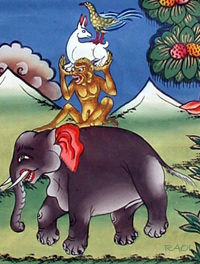
He explained the animals are representations of Lord Buddha himself and his close advocates: the bird is Buddha himself, the rabbit is Sheribu (Shari Putra), the monkey Mou-Gelgi-Bu (Mugyalyana), and the elephant Kingau (Ananda). "The painting teaches most of the Bhutanese values of etiquette like respect for elders, cooperation, and generosity. You need not become a monk or a nun to practice religion, the four animals can be an example," said Dasho Lam Sanga.
In modern Bhutan, the concept of the Puen Zhi can also be interpreted as the basis of His Majesty's concept of Gross National Happiness, according to the scholar. "To achieve Gross National Happiness we need harmony and unity among the people. The four animals can be compared to the four pillars of GNH," he said.
The principal of Institute of Language and Cultural Studies, Lopon Lungten Gaytso, says the painting of the Puen Zhi, like many other Buddhist paintings, depicts Buddhist morals. "It depicts harmony, unity, and integrity despite their sizes and strength," he says. "It can be interpreted as the need of unity in the country despite having different races. People paint the four friends at home with a belief that there will be no separation, discord, and partition within the family."
Although the origin of the painting is difficult to trace scholars like Lam Sanga trace the origin to the forests in present day Varanasi in India. "It is a Buddhist concept because no Hindu epics say anything about it although the story took place in India," he says.
The story of the four friends was an account Lord Buddha narrated to his disciples. The story goes thus: Once in a forest in Varanasi, four animals, an elephant, a rabbit, a monkey, and a bird (partridge) disputed about the ownership of a tree where all of them happened to come to feed on. The elephant claimed it was his because he saw it first.
The monkey said that it was his because he had been feeding on the fruits of the tree. The rabbit claimed that he had been feeding on the leaves of the tree when it was a small sapling. The partridge who had been watching the argument said that the tree belonged to it because the tree wouldn't have grown if it had not spit out the seed from fruit it had eaten.
The elephant, monkey, and rabbit, all then bowed to the partridge and regarded it as their bigger brother. The four animals became friends and decided to share the tree together in peaceful harmony enjoying the beauty of the tree's fragrance, the nourishment of the tree's fruits, and the bounty of the tree's shade.
Other animals in the forest often saw them together with the partridge on top of the rabbit who was held up by the monkey who rode on top of the elephant. Henceforth, they were called "the four harmonious brothers". The four animals were looked upon as an example and peace regained in the forest.
According to another account, In one of the Buddha's previous lifetimes, in the forest of Kashika, there lived four noble beings - a bird, a monkey, a rabbit, and an elephant. The four, who drank at the same spring, soon became friends. One day they decided that it would be proper to show the greatest respect for the eldest among them. To determine their respective ages, each one recalled the height of a nearby banyan tree when he had first seen it.
The four then showed each other respect accordingly. The elephant placed the bird on the crown of his head, the rabbit on his neck, and the monkey on his back. Then the bird said, "Now we must keep the five basic disciplines throughout our lives."
This they did, and to ensure that all other beings did the same, the bird initiated all those with wings, the elephant initiated all those with fangs, the rabbit initiated all those with paws, and the monkey initiated all those with fur. Thus, these animals are depicted in Buddhist art as a portrait of harmony.
There are about five different version of the story, but according to Dasho Lam Sanga, they all had the same moral- respect to elders, love and affection to live harmoniously. "None of the animals were primarily concerned with themselves," he said. "Each of the animals was concerned with trying to help the others rather than being dominated by selfish concern."
According to a former Dzongkha lopon, wherever a picture of the four brothers is displayed, the ten virtues will increase and the minds of all will become harmonious. "The painting is an example of cooperation, unity and harmony, as such it is painted in places like lhakhangs where people gathered," Thinley Wangchuk said.
While the story of the painting originated from the forests in India, nobody knows who painted the first Puen Zhi or where it was done.
Internet sources say that Tibetan families used the picture of the painting as letters of advice to families who were going through difficult times. "The four friends are often used as an example of how the family needs to stay together and help each other," an Internet source, Vinayavastu (foundation of Discipline) says.
Bhutan's renowned painter, 73-year old Lhadip Ugen Lhundup says that the paintings could have originated in Tibet and came to Bhutan when Shabdrung Ngawang Namgyal brought along Lhadips with him in 1616. Lhadip Ugen Lhundup who started painting since 1950 say the paintings of the Puen Zhi was there on frescos of dzongs and monasteries. "It could have done during the era of Gyelse Tenzin Rabgye who renovated and reconstructed many dzongs and lhakhangs in Bhutan," he said. "The theme of the paintings could have originated from the Kanjur and the Tenjur."
Unlike western art, Bhutanese arts, especially paintings are difficult to trace since paintings were considered an act of devotion, according to the Lhadip. The co-founder and tutor of Bhutan's only art studio, Volunteer Artist Studio of Thimphu (VAST) Kama Wangdi agrees.
According to Kama Wangdi, a traditional Bhutanese artist never signed his finished work because it was not serving the artistic value. "Traditional artists were viewed as religious icons. Their perspective was not important as long it served the religious purposes," he says.
One reason why painters never signed their work could be because most painters were commissioned to work, Kama Wangdi adds. "When a painting or a Thanka is commissioned, an artist considers it as a gewa (doing virtuous deed). Signing it would distort the importance of the work. The value of artist loses after he completes his work. Once the painting or the Thanka is consecrated, it loses the art value."
This is why Farmer Rinchen only hangs her Thanka during her annual rituals and painted the Puen Zhi on the wall of her altar room. "If you pray to this painting, it will pacify conflicts and bring harmony in the family," she says.
|
| This article was contributed by Ugyen Penjore , KUENSEL, Bhutan's National Newspaper |

|
|
 |
 |
 |
 |
|
 |
 |
|
 |
 |