|
Bhutan Festivals |
|
Bhutan Information |
|
|
 |
|
|
TSHECHU (RELIGIOUS FESTIVAL) |
 |
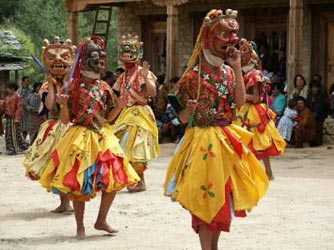 |
| Tshechu Mask Dance |
| The
Tshechu is a festival in honour of Padmasambhava-"one who was born
from a lotus flower", popularly known under the name of "Guru Rimpoche",
the Precious Teacher. This Indian saint contributed enormously to the diffusion
of Tantric Buddhism in the Himalayan regions of Tibet, Nepal, Bhutan
etc. around 800A.D. He is the fonder of Nyingmapa, the "old school"
of Lamaism, which still has numerous followers. The biography of Guru Rimpoche
is highlighted by 12 episodes on the model of Buddha Shakyamuni's
life. |
|
Each episode is commemorated around the year on the 10th day of the
month by "The Tshechu" which has become the name of a very popular
festival.
The
dates and the duration of the festival vary from one district to another
but they always take place on or around the 10th day of the month according
to the Bhutanese calendar.
During
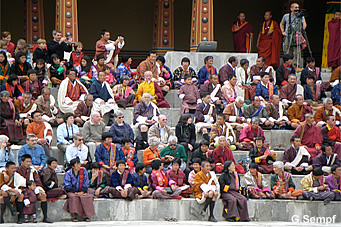
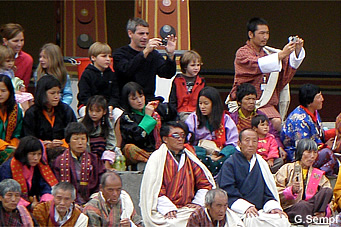
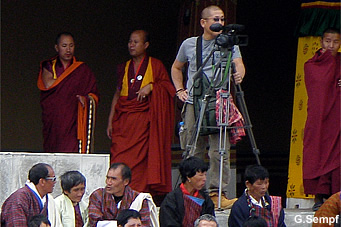
Tshechus, the dances are performed by monks as well as by laymen. The Tshechu
is a religious festival and by attending it, it is believed one gains merits.
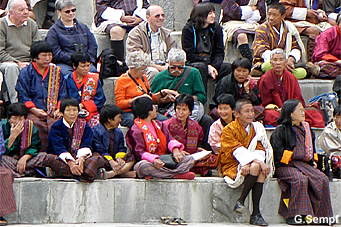
It is also a yearly social gathering where the people come together to
rejoice dressed in all their finery.
top
|
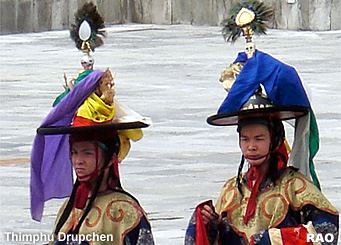
Thimphu
TSHECHU Tshechu ground to accommodate 25,000 viewers |
 |
Both
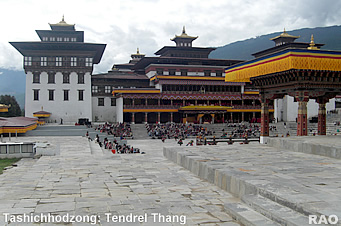
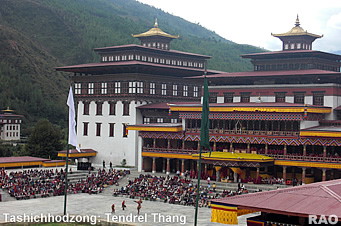
tourists and tshechu goers in Thimphu have complained about the crowded
courtyard of the Tashichhdzong during the annual three-day Thimphu tshechu.
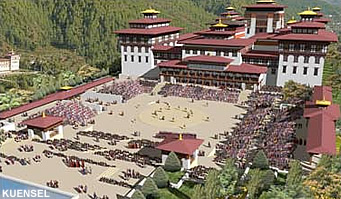 |
| The model of the tshechu ground |
|
Come
2008 and tshechu goers will breath comfortably with the construction of
a tshechuground behind the dzong well in progress.
According
to dzongkhag officials, the new ground measuring an area of 90,000 square
feet will comfortably hold 25,000 viewers with separate space for changing
rooms, security rooms, and a three-storied 'zeeree' for Royalty, senior
officials and VIP guests.
|
|
Thimphu
dzongda, Chencho Tshering, said that work has been divided into three phases
and would be completed by the end of the year.
The
first phase, site development, which started on 9 January 2008, will be
completed in 50 days, he said.
Thimphu
dzongda, Chencho Tshering, said that work has been divided into three phases
and would be completed by the end of the year.
Stone
slabs will be laid for the Dochen (court yard) in the second phase.
"The changing rooms, security rooms, and the public toilets will also be
constructed in the second phase immediately after the site development."
"With
increasing number of tourists and local tshechu goers, the capacity of
the courtyard had always been a concern," said a Thimphu dzongkhag official.
Rinson
construction who is developing the site at Nu. 6.9 million said that the
work would be completed within the scheduled time.
The
construction work is managed by the Dzong maintenance Division.
People
passing by the construction site, meanwhile said that the construction
comes as a big relief.
"I
have to wake up before dawn and rush to the courtyard to reserve place
for my family," said Penjor from Taba. "The tshechu comes only once in
a year and it is very difficult to see anything when we are late," he said.
|
| Contributed
by Passang Norbu, KUENSEL, Bhutan's national newspaper 2007 |
top
|
SIGNIFICANCE
OF THE MASK DANCES |
|
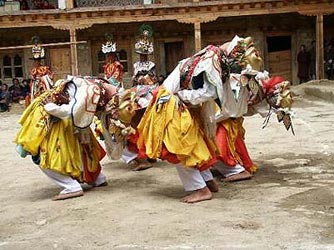 |
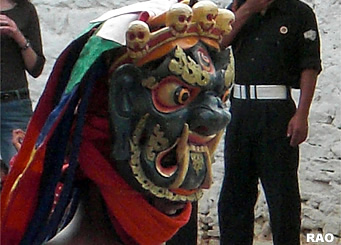
| Durdag Chham - Dance of the Cremation Ground |
|
Dance
and music play a very important part in the cultural life of people. Each
village and community has a rich tradition of dance, which marks the passing
seasons, communal occasions and shared experiences. Just like the building
of the dzongs and the setting up of the Chhoesi System, the dances have
had a similar part to play in helping to unite the people. Through these
dances, the ordinary people come to know their place in the history of
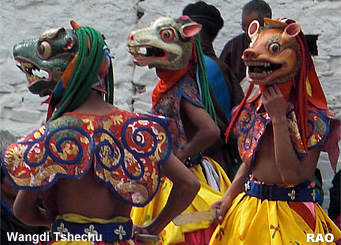
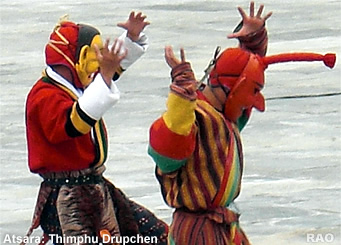
the country. Chhams "Religious Mask Dances" are usually performed during
Tshechus.
The
Chhams were composed mainly to convey religious messages to the people.
|
|
 |
 |
Some
were composed by Guru Rimpoche while others were created by Tertoen Pema
Lingpa, Zhabdrung Rimpoche and other great saints. During the mask dances,
the deities of the tantric teachings are invoked and through their power
and blessings, misfortunes are removed. All evil spirits and demons which
are preventing the spread of Chhoe "The Doctrine" are suppressed so that
the doctrine of Lord Buddha flourish and bring joy and happiness to all
sentient beings.
| Information on Bhutan |
|
|