| You are here: | RAO Home > Bhutan > Topics > Politics > King's address | Search |
 |
| Bhutan - Politics |
| Government |
|
 |


 |
  |
 |
| 2006: His Majesty addresses the Lhengye Zhungtsho |
 |
|
 |
|
His
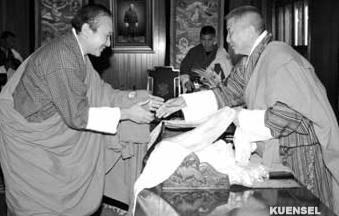
Majesty the King, who meets formally with the Lhengye Zhungtsho during
the handing over of the prime ministership every year, addressed and exchanged
views with the cabinet members on important issues facing the country and the tasks to be fulfilled by the government in the year ahead.
| Implementation of the Ninth Plan |
|
His Majesty said that although the cabinet had extended the Ninth Plan by a year to June 2008, it was better to complete the Ninth Plan programmes by December 2007. It would not be very feasible to concentrate on completing development programmes in 2008 when historic events like the establishment of parliamentary democracy and general elections to elect a new government would be taking place in the same year.
His Majesty reminded the Lhengye Zhungtsho that besides the development programmes funded by international donors, Ninth Plan programmes with a total funding Nu.5,565.00 million from the Government of India were yet to be started. It was important to complete these programmes in the Ninth Plan itself so that the financial assistance committed for them does not spill over to the 10th Plan. His Majesty advised the government to make every effort to complete these programmes by the end of 2007 and also hold discussions with the government of India on the utilisation of the development assistance provided by them.
| 10th Plan |
|
Another important responsibility of the Lhengye Zhungtsho, His Majesty said, was to draw up the 10th Plan (July 2008 ? June 2013) and mobilise the funds for its implementation. Although the budget for the 10th Plan had been projected at Nu.110 billion, the government had neither drawn up the Plan activities nor started mobilisation of funds.
"If not late, it is certainly not too early to start mobilising assistance for the Tenth Plan from our closest neighbour and friend India and other donor countries," His Majesty said. "If it is left to the newly elected government in 2008 to seek the funds required for the 10th Plan it will be extremely difficult for them to start the Plan activities on time and complete them successfully."
This
would adversely affect the success of parliamentary democracy in Bhutan
as the new government would not be able to implement the development programmes
and fulfill the aspirations of the people, resulting in the electorate
losing faith and support in the very first government under the new political
system. His Majesty, therefore, called upon the Prime Minister and the
Cabinet to give the highest importance towards mobilising funds for the
Tenth Plan.
| Employment |
|
His Majesty emphasised the responsibility of the government to provide employment to the Bhutanese youth.
Although the unemployment rate was projected at three percent for 2005, His Majesty was of the view that the figure may not be accurate because every time 10 to 11 vacancies were announced about 500 to 600 youths would rush to apply for the jobs.
"If the nation is to have joyous celebrations in 2008, it is necessary for the people to be happy and to achieve this it is very important to implement development programmes successfully and provide employment to every Bhutanese," His Majesty said. "Therefore, rather than just trying to reduce the rate of unemployment the government should declare it as a policy objective to remove this problem when the nation celebrates the historic events that will take place in 2008."
Although Bhutan's population was very small, it already had a student population of 160,000 and this would increase to more than 200,000 within two to three years. The pressure on the government to provide employment to the youth would, therefore, rise every year. The Ministry of Labour and Employment was in a very difficult situation in view of the present availability of jobs in the government and the private sector. While thousands of jobs would be created when major power projects like the Punatsangchu phase I and II, the Mangdechu Project and the Dungsam Cement project would commence, the unemployment pressure would continue for the time being.
His Majesty, therefore, recommended the establishment of a Trust Fund for employment related problems. In 1989, the government had decided to create a Future Generation Fund but it had not materialised because of the Ngolop problem in the 1990s. His Majesty suggested that the government should set aside US $ 100 million to create a trust fund for youth employment.
His Majesty reminded the cabinet that it would be useful to create trust funds because the money invested in such funds would be more secure than money kept in the country's hard currency reserves. It was always possible for future governments to use up the hard currency reserves of US $ 513 million, which had been built up with much difficulty over the years.
The
money in a Trust Fund, on the other hand, would be utilised only for the
purpose for which it was created and, if it was needed for any national
emergency, only the parliament would have the authority to sanction its
utilisation.
| 2008 Celebrations |
|
His Majesty reminded the Lhengye Zhungtsho that the celebrations to mark the three historic events- the coronation of the Fifth Druk Gyalpo, the centenary of the establishment of the monarchy and the establishment of parliamentary democracy in Bhutan-will be held together in 2008.
"There will be no happier time for Bhutan than when we hold the celebrations in 2008," His Majesty said. "However, the celebrations should be conducted properly in keeping with our traditions without incurring unnecessary expenditure at the cost of development activities." His Majesty emphasised that the celebrations should not become a source of criticism for the government but, instead, must be conducted in a manner and at a level that will be appreciated by the people of Bhutan and by outside observers.
| Infrastructure |
|
His Majesty said that there were many construction works planned to be completed before 2008 and advised the Lhengye Zhungtsho to prioritise these works carefully so that time and money will not be wasted unnecessarily.
His Majesty recommended that the reconstruction of the government offices near the Trashichhodzong should be kept on hold for now as the constructions would not be completed in time for the celebrations in 2008. The offices could be renovated and used until the new constructions were carried out when funds became available. The plan for the construction of a new secretariat building behind the dzong should also be taken up later by the new government when funds were available.
The plan to construct a new National Council building should also be kept on hold, as it will not be completed in time for the establishment of parliamentary democracy, His Majesty said. The Royal Banquet Hall, which had two conference halls, could be renovated as already planned and used by the 25-member National Council.
His Majesty also advised the Lhengye Zhungtsho against the construction of a housing complex in Taba for the members of parliament. Such accommodations would have to be built like hotels and would not be very practical for the government. It would be more beneficial and cost effective to provide the members with good daily living allowances. Those members who had relatives in Thimphu could benefit by staying with them while others could use the enhanced allowances to stay in hotels which in turn would benefit the hotel industry.
Regarding the plan to build a facility outside the Trashichhodzong to hold the annual Thimphu Tshechu, His Majesty agreed that it was necessary for a larger place outside the dzong to accommodate the increasing number of spectators every year. It was not a good sight to see the Bhutanese people watching the Tshechu from rooftops, attics and other inconvenient places while tourists were accommodated in the main courtyard. The Lhengye Zhungtsho should, therefore, take an appropriate decision on this matter.
One important construction that must be completed by 2008 is the Supreme Court, His Majesty said. The Supreme Court had a very important role to play under the Constitution and, as the Government of India had already agreed to fund the construction, it must be started and completed in time for the establishment of the new political system in Bhutan.
His Majesty reminded the cabinet members that it was also important to complete the construction of the residential houses for the prime minister, ministers and constitutional post holders by 2008 as it would not be proper for these office holders to live in private houses in town.
It would also be more cost effective and convenient to provide security for these office holders if their residential quarters were located in one area. Furthermore, these houses could also be used as guesthouses during the 2008 celebrations before being handed over to their new residents.
His Majesty reminded the cabinet members that the Kuengacholing and Lhuendupling state guesthouses had become old and could no longer be used to accommodate state guests. The Lhengye Zhungtsho should decide whether a proper state guesthouse should be built at the same site or in another location. As suggested by His Majesty some time earlier, the cabinet members should also decide whether the site should be used for the residence of the prime minister.
Another
infrastructure that needs improvement is the Changlimithang stadium which
had not seen much renovation since the Coronation in 1974, His Majesty
said. As many of the celebrations in 2008 will be held in the Changlimithang
grounds, necessary improvements and preparations must be carried out.
| Responsibilities of the new King |
|
His Majesty informed the Lhengye Zhungtsho that he would be stepping aside soon and delegating his responsibilities to His Royal Highness the Crown Prince. His Majesty explained that it was very important for the Crown Prince to gain experience in discharging the full responsibilities of the King. At present, he was not gaining any real experience as the responsibilities were being carried out by His Majesty himself. The cabinet members should not be dismayed with the decision as they were already aware of it and these steps were being taken in the interest of the nation.
His Majesty said the responsibility of introducing a new system of government and parliamentary democracy in Bhutan did not lie with the Lhengye Zhungtsho. It was the new King who must usher in the new system and ensure the success of parliamentary democracy in Bhutan in keeping with the provisions enshrined in the Constitution.
"This is a sacred responsibility to the nation that you must shoulder with utmost loyalty and dedication," His Majesty said to the Crown Prince. "We repose our full faith and trust in you to serve the people and country better than myself and all the Kings who have come before you."
His Majesty commended Lyonpo Sangay Ngedup for his successful tenure as the eighth prime minister since the devolution of full executive powers to an elected Cabinet in 1998 and extended his appreciation and Tashi Delek to him for serving the country and people with loyalty and dedication.
His Majesty also extended his Tashi Delek to the new prime minister, Lyonpo Khandu Wangchuk and reminded him that there were many important tasks to be carried out by him and the government during his tenure, including the preparations for the historic events in 2008.
| Appreciation by outgoing Prime Minister |
|
The outgoing prime minister, Lyonpo Sangay Ngedup, expressed his appreciation and gratitude to His Majesty the King on behalf of the Lhengye Zungtsho for further strengthening the close relationship and cooperation between Bhutan and India, for the signing of the Bhutan-India trade agreement and finalising the Tala export tariff rate during His Majesty's recent working visit to India.
The outgoing prime minister also expressed his appreciation to His Majesty the King and the Crown Prince for tirelessly and successfully conducting the public consultation meetings on the draft Constitution in all the 20 dzongkhags.
"I
have been able to fulfill my duties because of His Majesty's benevolent
guidance and unfailing support and also because of the hard work and cooperation
from the members of the cabinet and my colleagues," said Lyonpo Sangay
Ngedup. "I have been fortunate to have served as the head of the government
on two occasions in a single lifetime which has given the opportunity to
serve my King, people and the country. The opportunity to serve the King
and country has brought a profound meaning to my life and I pray that even
in my next life I could be born to serve my King again."
| Pledge by the new Prime Minister |
|
Pledging his service to King, country and the people, the new prime minister, Lyonpo Khandu Wangchuk, said that the main responsibility of the government during his tenure would be enhancing and strengthening the sovereignty and security of the country and the well-being of the people. He said the government would work hard towards bringing about equitable socio-economic development, provide fair and timely service to the people, properly utilise public resources, and enact and implement laws for fair and equal treatment.
"People should ensure that we have a strong, capable and honest government that is deeply committed to carry out its responsibilities," said Lyonpo Khandu Wangchuk. "We must bear in mind that if we go wrong, all that His Majesty has built with selfless and dedicated work could be ruined in a short time."
The prime minister said that the year ahead was full of important tasks like preparing for the Coronation of the Fifth Druk Gyalpo, the Centenary celebrations and the establishment of parliamentary democracy in 2008. He added that the government would also work towards successfully completing the 9th Plan and finalising the 10th Plan development programmes besides developing the private sector to generate employment. "I am deeply honoured to have the privilege of serving His Majesty and the people for the second time," he said. "In serving the country and the people, I seek the guidance of His Majesty and the support of the people, the national assembly, the judiciary, and the cabinet colleagues and the civil servants."
Lyonpo Khandu Wangchuk, on behalf of the cabinet, pledged to serve the Crown Prince with unfailing loyalty and dedication when the Crown Prince takes over the responsibilities of His Majesty the King.
|
| Contributed by KUENSEL Bhutan's National Newspaper, September 2006 |
 |
|
 |
|
 |
 |
|
 |
 |