|
Bhutan
- Ethnic Groups & People
|
 |
Bhutan's People Merak - Sakten |
|
|
Bhutan Information |
|
|
 |
|
Brokpa
or Sagtengpa or Dakpa
|

|
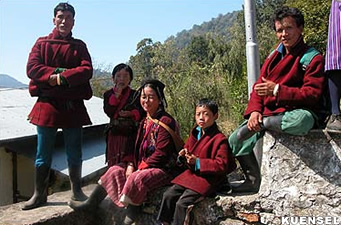 |
| Brokpa people |
| The
65,500 Brokpa (also known as the Sagtengpa or Dakpa) are
one of the many tribal groups. It is possible that they are related to
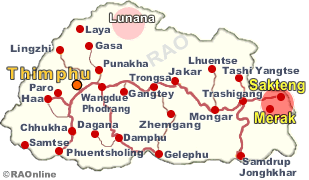
the Limbu of Nepal. They live in the eastern part of the country, mainly
in the Sakteng Valley. They speak a language called Mira Sagtengpa
(or Brokpa).
What Are Their Lives Like Most of the Brokpa (Dakpa) are farmers. Their principal crops include corn, barley, and beets.
|
|
They
work long hours in the fields in order to produce enough to feed their
families. Other important activities include herding yaks and sheep, and
spinning and weaving wool.
Most
farmers also keep a few pigs and chickens. The yaks are used as
beasts of burden. They also supply the families with meat and milk. Since
only about 3% of the land in Bhutan is available for agriculture, the fields
are often built in terraces up the mountain sides. Cultivation practices
have changed little over the centuries, and most of the labor is provided
by family members.
top
|
The
Brokpa community
|
|
|
 |
The
Brokpa (Dakpa) women wear their hair long and dress in traditional styles.
They typically wear red and white silk ponchos, red silk jackets decorated
with animal designs, and red wool capes. They may also wear braided black
wool jackets. The men wear leather or cloth pants under big, white
wool trousers; red wool jackets; and sometimes sleeveless outer garments
made of leather and felt. Both men and women wear turquoise earrings. The
most distinctive part of the Brokpa (Dakpa) outfit, however, is the unique
felt hat. |
The
hats are flat, felt discs made from yak hair. Each hat has five tail-like
"spouts" that allow water to drain and the head to stay dry.
Social
status among the Brokpa (Dakpa) is based on a family's economic position.
There is no caste (rigid social class) system except among the Hindu Nepalese
in the southern region. The royal family and a few other noble families
are the only people in Bhutan who have surnames. Individuals normally have two
names, but neither is considered a family name. Wives keep their maiden
names, and children may have names that are not connected to either
parent.
The
Brokpa (Dakpa) are virtually 100% Buddhist. They follow the "Red Hat"
sect of Tibetan Buddhism. In addition, traditional Tibetan shamanism
is also practiced by some. The shamanists believe in an unseen world of
gods, demons, and ancestral spirits. They depend on a shaman (priest
or priestess) to communicate with the spirits on their behalf. Most
Buddhist families have shrines for worship inside their homes. A poor family
may have only a small Buddhist image or painting rather than a shrine.
However, a wealthy family may use an entire room as a shrine, furnishing
it with an elaborate altar, lamps, an incense burner, and other religious
items.

|
| Contributed
by KUENSEL, Bhutan's National Newspaper |
top
|
The
Brokpa people
|
|
|
|
Languages |
People
name:
|
Brokpa
(Dakpa)
|
| Language: |
Mira
Sagtengpa |
| Population: |
| (1990)
61,800 |
| (1995)
65,500 |
| (2000)
73,700 |
|
| Religion: |
Buddhist
99.9% |
| Scriptures
in their own language: |
None |
|
BROKKAT
Dur
in central Bumthang District
Alternate
names: BROKSKAD
Classification:
Sino-Tibetan, Tibeto-Burman, Himalayish, Tibeto-Kanauri, Tibetic, Tibetan,
Southern
BROKPAKE
5,000
including 2,000 in and around Mera, 3,000 in and around Sagteng Sakteng
Valley east of Trashigang District
Alternate
names: MIRA SAGTENGPA, DAKPA, BROKPA, DAP, MERA SAGTENGPA, SAGTENGPA, MERAGSAGSTENGKHA.
Classification:
Sino-Tibetan, Tibeto-Burman, Himalayish, Tibeto-Kanauri, Tibetic, Tibetan,
Southern
DAKPAKHA
1,000
Near
Brokpake
Classification:
Sino-Tibetan, Tibeto-Burman, Himalayish, Tibeto-Kanauri, Tibetic, Tibetan,
Eastern |
top
| more
information |
|
|










