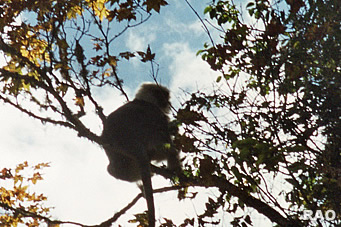
| Bhutan's
Nature - Animals |
 |
Bhutan Nature Animals |
|
Bhutan Information |
|
|
 |
| Golden
Langurs |
 |
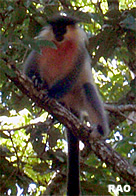
The
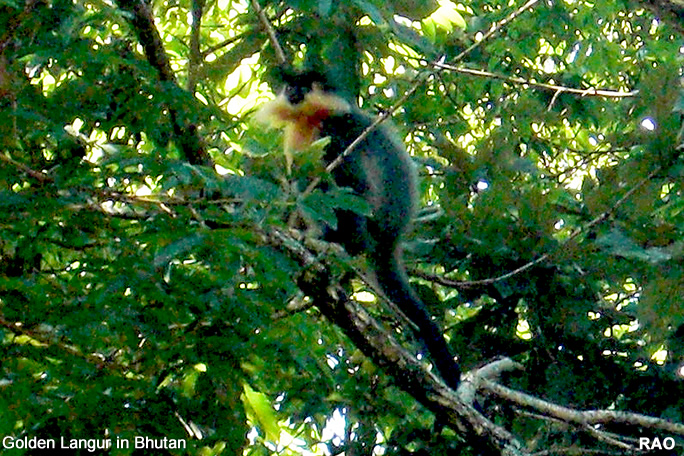
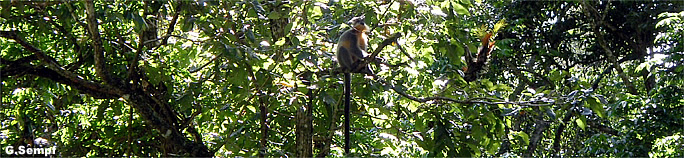
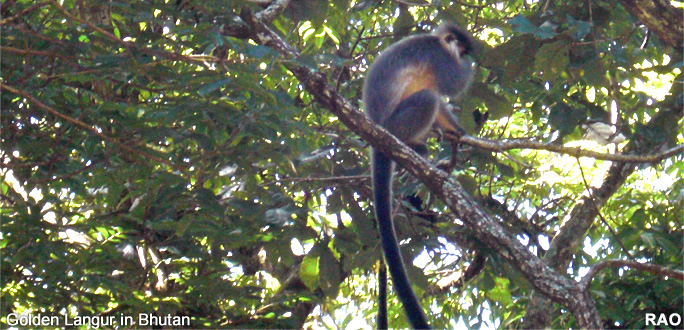
distribution of golden langurs (Trachypithecus geei) is limited to a small
area of western Assam in northeast India and Bhutan between the rivers Manas (India) in the east, Sunkoshi in the west, and Brahmaputra in the
south. It is one of the most seriously endangered primate species of the
subcontinent.
 |
|
It probably evolved in geographic isolation on the western
side of the Manas river. On the other side of the river is its close cousin,
the capped langur. No golden langurs are found on the river's eastern side.
A
comparative analysis based on satellite images taken in 1988 and 1998 showed
a 50% loss of original golden langur habitat. An average group size of
8.2 (range from 4.0 to 22.0) individuals was recorded. A total of
1,064 individuals were counted living in 130 groups. The sex ratio was
1.9-2.5 adult females for each adult male. Most of the groups had only
one adult male.
|
|
The
diet of the langur - a vegetarian - is composed mainly of mature leaves,
but it also eats young leaves and fruit.
During
the monsoon season, fruit may comprise up to 50 percent of the langur's
diet. Feeding strategy is adapted to cope with seasonal food scarcity.
Langurs seldom leave the trees, even to drink from streams. They take water
from dew or rain drenched leaves. They live in troops of as many as 40.
| Grey langurs |
 |
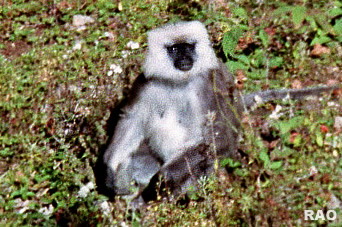 |
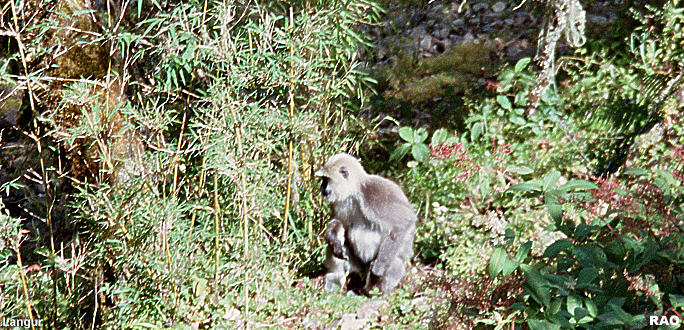
Gray langur (Semnopithecus hector)
The grey langur is native to Bhutan, India and Nepal.
The grey langur is also known as the Hanuman langur after the monkey-god Hanuman, and is considered sacred in the Hindu religion. |
|
top
| Wildlife and People in Bhutan |
|
| Information on Bhutan |
|
| Links |
|
|