|
Bhutan's
Nature - Animals
|
 |
Bhutan Nature Animals |
|
|
Bhutan Information |
|
|
 |
| White-bellied
Heron in Wangdue Phodrang and Zhemgang |
 |
 |
White-bellied Heron
Bhutan
is a home to one of the most endangered bird species in the world, the
White-bellied Heron (Ardea insignis) according to the royal society for
the protection of nature RSPN. Out of the 20 to 200 white-bellied heron
estimated population worldwide, the society has confirmed five herons in
the Punakha-Wangdue Phodrang region. |
|
A spokesman for the society said that,
although no detailed study or proper census of the rare bird was carried
out, about eight herons were reported to have been spotted in Bhutan.
The
heron, recorded only in Nepal, India, Bangladesh, North Myanmar, and now
in Bhutan is classified as the most threatened bird species among the 50
rarest bird species in the BirdLife International red Data Book.
| Kamechu
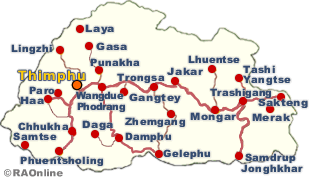
region in Wangdue Phodrang: Heron sighted |
 |
A
family of three herons was spotted in the Kamechu region in Wangdue Phodrang,
while another two herons were confirmed in Sha Ada lake area in Wangdue Phodrang.
Another two herons was sighted along the Pho Chhu river in Punakha, but
officials doubt that they could have migrated from Ada lake. "We have confirmed
five, but we are not sure of the rest because they could be from the same
count," research Coordinator, Mirage Pradhan said. |
A white-bellied heron
was reported to have been spotted in Tingtibi, Zhemgang, but RSPN
officials say that a study will be carried out soon to confirm the presence
in Zhemgang.
White-bellied
heron can be identified from their long legs for wading, grayish slender
body with long head and neck, and huge thick bill. Although big in size,
it is difficult to see because it's colour camouflages it in the surroundings.
| Bhutan
Royal Society of Protection of Nature: Great discovery |
However,
the greatest discovery, according to RSPN is the spotting of a heron nest
in Kamichu. The last heron nest was spotted in Myanmar in 1929 according
to Mirage. "This bird is more Bhutanese than the popular black-necked crane,"
he added meaning that the black-necked crane was present only seasonally
in Bhutan. Nicknamed the 'gentle giant' because of its gentle nature and
the huge size, the heron mostly feeds on fishes and smaller insects. Although
the heron measures about 1 to 1.5 metres high, smaller birds like dragons,
crows, and even the Himalayan bulbul easily intimidate the heron while
sharing its habitat.
A
study report from the society says that the heron habitat in chirpine forest
at an altitude between 800 to 1500 metres from the sea level. Once widespread
in India and Nepal, these herons disappeared from most of their original
range. According to Mirage, loss of habitat could be most threatening to
the survival of the heron. "Rock extraction and other activities along
the river shores is disturbing the habitat of the heron," he said. Internet
source identifies destruction of forest and tall grassland, and reclamation
of wetlands as potential threats to the heron.
Meanwhile,
the society is planning to radio band the birds to keep track of their
migratory patterns and the distribution of the birds in Bhutan. There is
also a proposal to include the white-bellied heron under Schedule I of
the Forest and Nature Conservation Act.
| Contributed
by Ugyen Penjorei, KUENSEL,
Bhutan's National Newspaper 2006 |
 |
top
| Wildlife and People in Bhutan |
|
| Information on Bhutan |
|
| Links |
|
 |
|
External
links |
 |
Bhutan
Ministry of Agriculture
Renewable
Natural Resources
MOA |
|
|
 |
|











