|
Bhutan's
Nature - Animals
|
 |
Bhutan Nature Animals |
|
|
Bhutan Information |
|
|
 |
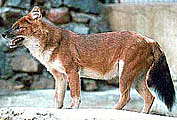 |
| DHOLE Cuon primaevus |
"Dhole"
comes from the Anglo/Indian word "tola," which means "wolf." "Dog" comes
from the Old English word "daga," for the animal. he Dhole, Red Dog or
Asiatic Wild Dog is a fairly large (10 - 20 kg) pack-living canid found
in thick scrub jungles and dense forests up to 3000 m throughout mainland
southeast Asia from India to eastern China, and on the islands of Java
and Sumatra. |
|
| About
Wild Dogs |
 |
|
 |
| Name |
DHOLE Cuon primaevus in Bhutan |
| Habitat |
Eastern
Asia from India to China, and as far south as Java (Indonesia). They typically
live in the forested areas in their range. |
| Diet |
Its
main prey is large mammals (deer, wild sheep, goats, spotted deer, sambar
deer, wild sheep, small deer, rodents, rabbits and even water buffalo).
They
hunt the larger animals in a pack unit. Dholes can kill animals up to ten
times their own size, and often drives its prey into the water. They tend
to avoid humans. |
Physical
Appearance |
The
coat is a distinctive rust color on the back, and paler underneath. The
tail usually has a black tip. The female has 16 nipples. This species has
40 teeth. The head and body are 35 to 45 inches long with the tail adding
16 to 20 inches. They weigh 30 to 46 pounds. Their ears are rounded and
large, and are filled with white hair. The dhole's hair is longer and lighter-colored
in the northern parts of their range, and darker and shorter in the southern
parts of their range. They have a short square muzzle that enables them
to have a very powerful bite. |
Social
Behavior |
Dholes
live in packs of 5-12 individuals, with some packs exceeding 25 members,
with most members being related in some way. In many packs that have been
studied, there were twice as many males as females in the pack. Fighting
is not common as there is a strict hierarchy. The females are very social
and have been known to share their dens with other breeding females. All
members of the pack care for the cubs and carry them food back from a hunt.
The pups will not leave the denning area until they are 10 weeks old. During
this time, they will fight to establish a dominance order, even at that
young age. Dholes are mature at one year, and they may or may not leave
the pack.
Dhole
keep a large territory, from 40-84 sq km. They are primarily diurnal and
crepuscular, but are occasional active at night. |
|
|
|
top
| Wildlife and People in Bhutan |
|
| Information on Bhutan |
|
| Links |
|
|











