|
Bhutan's
Nature - Animals
|
 |
Bhutan Nature Animals |
|
|
Bhutan Information |
|
|
 |
| Black-Necked Cranes flying all the way fromTibetan plateau |
 |
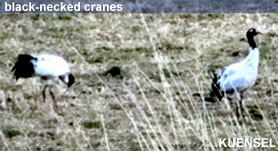
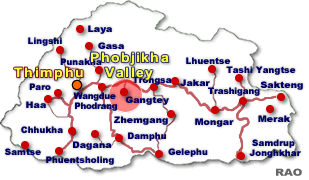
Black-Necked Crane flying all the way from the barren hills of the Tibetan plateau, and catching a glimpse of the mighty Himalayas as they flew over them, Gangtep and his wife have returned to Phobjikha.
The winged visitors safely touched down on their roosting ground covering more than 107sqkm.
On this occasion, however, their five-month-old juvenile accompanies the black-necked crane couple.
 |
| The name Gangtep, was given to the male crane that has been flying to Phobjikha every year since 2006, after Royal Society for Protection of Nature officials put on its first 'platform telemetry transmitter', to help identify and track it.
The transmitter helps track the migratory patterns of the birds, and allows researchers to obtain up-to-date location points, roosting, resting and feeding grounds.
|
|
Gangtep's other juvenile, which was spotted in 2006 and wore the same transmitter, however, has not returned ever since.
Similarly, a crane couple, tagged with the same transmitter, also stopped flying into the valley since 2010.
The society's field coordinator at Phobjikha, Tshering Choki, said she wondered whether the cranes even existed.
She said there could be many more cranes that did not return after they flocked to their summer habitat, Bamtsho in southern Tibet.
 |
International centre for integrated mountain development (ICIDOM) officials feel that measures taken at one side were inadequate to maintain records and conserve vulnerable flocks, given the threat of rising temperatures and economic development.
ICIMOD's director general, Andreas Schild, said, it was too inadequate an effort to conserve and protect the birds in Bhutan, unless the same was done during other parts of the year in China.
|
"To understand the habitat and the life cycle of the cranes, it's important to understand their situation in China as well," he said.
As the regional knowledge development and learning centre serving the eight regional member countries of the Hindu Kush-Himalayas, the centre, he said, was looking at possibilities to facilitate RSPN and Ugyen Wangchuck Institute for Conservation and Environment (UWICE) to begin trans-boundary research.
"It'll greatly benefit in understanding the winter as well as summer habitats of the birds, and thereby finding ways to go about conserving them," he said. "Since we've close contact with Chinese partners, we could play a critical role here."
The only trans-boundary research took place sometime in 2000, when a team from RSPN and nature conservation division went to Shensa in China and banded 18 juveniles to see whether they flew to Bhutan.
"But so far none of them came," Tshering Choki said.
In getting more and accurate information, the UNWICE this year will switch to more advanced technology in satellite tags, which cost about 1,500 euros a piece.
Average crane arrival in Bhutan from the 1990-91 to 2010-11 winter period was 418 a year.
In the winter of 2010, 347 cranes visited Phobjikha and 94 Bumdeling, as opposed with 326 cranes that visited Phobjikha in 2009 and 123 Bumdeling.
This winter 41 cranes have arrived in Bumdeling, 16 in Uruk, Bumthang and 247 in Phobjikha.
Of the estimated 11,000 global black-necked crane population, 500 of them fly to Bhutan in winter.
| Contributed
by Tenzin Namgyel, KUENSEL, Bhutan's National Newspaper 2011 |
|
top
| Wildlife and People in Bhutan |
|
| Information on Bhutan |
|
| Links |
|
|