| Despite
spending sleepless nights in the fields keeping vigil, farmers of Phodrong
village in Tang are facing a difficult time guarding their sweet buckwheat
(gerey) from bears.
The
farmers stay awake till three to four in the morning with dogs tied near
their makeshift huts and with bamboo mattings erected around the field
boundary.
They
also use powerful torches, which are kept on through the night. A farmer
said that he finished a pair of large size torch batteries within two nights
of vigil.
But
the bears wait till dawn, when sleep lies heavy on the farmer's eyelids,
to raid the fields. The destruction caused by the bears is different from
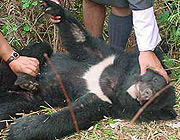
other animals. The bear usually sits in the field and drag themselves smashing
all the crops in its way.
According
to the people of Phodrong, the bears feed mostly on the sweet buckwheat
during this season. At this time the sweet buckwheat which is not fully
ripe is quite juicy. In other months they feed on tender plants, fruits
and wild berries known as marips in Bumthap.
Ugyen
Lhendup, 22, from Phodrong said that during the flowering season the bears
don't even come near the crop because it gives off an unpleasant smell.
Bears
also do not come to the fields when the crop are fully ripened because
by then the buckwheat would have become dry and hard.
Locally
known as charai, sweet buckwheat is an important cereal for the Bumthaps
chiefly because it is used to make their popular dishes, the puta and khuli.
There
are around 18 households in Phodrong village that grows sweet buckwheat
but the area under cultivation has come down in recent years because of
the bear menace.
The
crop is cultivated in February-March and are harvested in October and November. |