 |
Bhutan's Nature National Parks |
|
|
Bhutan Information |
|
|
 |
| Bhutan's
National Parks, Wildlife Sanctuaries and Nature Reserves |
|
| Bumdeling
Wildlife Sanctuary |
 |
Rehabilitating
the roosting ground
The Bumdeling
wildlife park officials in Trashiyangtse are waiting for the
last of the rains to go away so that they can start rehabilitating the
roosting grounds of the Black necked cranes.
| The
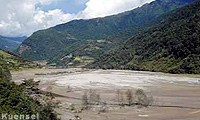
Black necked crane roosting area in Bumdeling valley |
|
The
endangered cranes descend to the Bumdeling valley from the high Tibetan
plateau in November and roost along the banks of the Kholongchu riverbank
for the next three months. The Kholongchu riverbank covered with
white wet sand has shallow and marshy areas of water which the cranes prefer.
|
|
 |
But
the constantly changing course of the Kholongchu which has been flooding
quite regularly for the past several years is affecting the roosting areas.
"It might, in time, change the roosting place of the cranes permanently,"
said the park ranger, Phurba Lhendup. "We are going to dig a channel around
the roosting area and artificially create an island where they can roost
permanently every winter."
top
| Black
necked crane: Digging channels to prevent attacks of predators |
|
The
Bumdeling wildlife officials plan to start digging channels from the source
of the river to keep water flowing around the marshy island. The island
will also be a safe resting ground for the cranes that are constantly threatened
by the presence of their common predators like large weasels, yellow
fronted Marten, wild cats and packs of stray dogs. "These common predators
have an easy access to the roosting areas at present," said the park ranger.
"Having their habitat surrounded by the river on all sides will prevent
predators from getting in so easily."
In
1998 a crane was attacked and killed by a yellow fronted Marten. Last year
the park officers found tracks of the yellow fronted Marten on the roosting
areas. The most disturbing and annoying to the cranes are the local
stray dogs that constantly attack the resting cranes at night and chase
them off when they are feeding off the harvested paddy fields during the
day. "They are a nuisance to the birds," Phurba Lhendup said.
Apart
from the animals, even people are a constant irritation to the cranes as
they take short cuts made through the roosting areas. "With flash lights
in their hands, their footsteps and voices scares the cranes," said the
park manager. "Children playing in the fields during the day chase the
cranes with sticks and stones, which we fear could cause the cranes to
permanently abandon the place."
| Human
encroachment |
|
According
to the records maintained by the Bumdeling wildlife sanctuary, the number
of cranes coming into the valley has neither increased nor decreased since
1998 and they would like to keep it that way. "About 148 to 150 cranes
fly into the valley every year, a fluctuation by about four or five
only," said the park ranger. "The highest number was in 1992 when 178 cranes
flew in, it decreased to 144 in 1998."
The
decrease, he said, could be attributed to human encroachment into the bird's
roosting grounds. "More houses, schools and roads were built in Bumdeling
and Trashiyangtse were the cranes lost most parts of their habitat and
feeding grounds," Phurba Lhendup said. Meanwhile, the range officers in
Bumdeling spotted two Eurasian cranes among the black necked cranes last
year and once in 1998.
According
to Phurba Lhendup, these Eurasian cranes go to Tibet during the breeding
season in summer but lose their flock returning to Eurasia. "Unable to
find their group, they land up joining the Black necked cranes to Bumdeling."
|
| Source: Tempa Wangdi, KUENSEL, Bhutan's National Newspaper 2012 |
| Ludlow's Swallowtail butterfly |
|
Local community says Ludlow's butterfly should be left undisturbed in its natural habitat
The community of Bumdeling gewog, Trashiyangtse want the endangered national butterfly, Ludlow's Swallowtail, found in Tobrang village under the gewog to be protected, conserved and researched within the community and not anywhere else.
 |
| After a pupa was taken, along with that of Bhutan Glory, to Ugyen Wangchuck institute for conservation and environment (UWICE) in Bumthang recently, villagers wanted it stopped, even if it were for research.
The community is also opposed to the idea of moving the endangered species, Ludlow's Swallowtail, to the royal botanical garden in Lamperi, Thimphu to promote tourism.
Bhutan Swallowtail, an endangered species, was named as the national butterfly in February 2012. |
|
British plant hunters Frank Ludlow and George Sherriff discovered Ludlow's Bhutan Swallowtail in 1933. Bhutanese forest guard, Karma Wangdi, now working with UWICE, rediscovered Bhutan Swallowtail in 2009.
Community members said, being an endangered species, they are wary that researchers chasing and ensnaring them could jeopardise its existence.
"Government should as far as possible protect the species from unnecessary disturbance in its natural habitat to prevent extinction," a villager from Bumdeling said.
The community members said researches and studies on Bhutan Swallowtail should be limited to its natural habitat in Bumdeling.
"Since its natural habitat will be the most suitable place for research on its lifecycle, studies must be restricted within Bumdeling, rather than being taken elsewhere," Trashiyangtse dzongkhag tshogdu chairperson, Cheku, said.
The chairperson also said there was no need to take the butterfly to either Lamperi or Bumthang to attract tourists. "If they want to see the butterfly, let them come to Bumdeling," he said. "Trashiyangtse is also popular for its religious sites and festivals."
"The community also feel that social clearance should be made necessary, prior to entertaining any researches on Bhutan Swallowtail," Bumdeling mangmi Pema Namgay said.
Bumdeling wildlife sanctuary (BWS) chief forest officer, Pankey Dukpa said no such initiatives have been discussed. "We aren't making any artificial habitat or breeding for Bhutan Swallowtail anywhere in Lamperi or Bumthang," he said.
"Those pupaes were taken to study lifecycle crucial to draw its management guideline. The community should understand that it's important to study its feeding, breeding and habitat for holistic protection of the butterfly," Pankey Dukpa said.
He also said that the pupaes, if they survive, will be brought back to their natural habitat. "The agreement has been with researchers that once it turns into a butterfly, it should be safely released to Bumdeling in presence of the community," Pankey Dukpa said.
BWS officials said foreigners, including researchers, would be barred from entry into Tobrang.The officiais have asked for security clearance from home ministry for foreigners wishing to enter the protected habitat of Bhutan Swallowtail.
Another official, ranger Sonam Choidup, said taking of samples related to the species would also be restricted.
|
| Source: Tempa Wangdi, KUENSEL, Bhutan's National Newspaper 2012 |
top
| Wildlife and People in Bhutan |
|
| Information on Bhutan |
|
|










