|
Bhutan Education |
|
|
 |
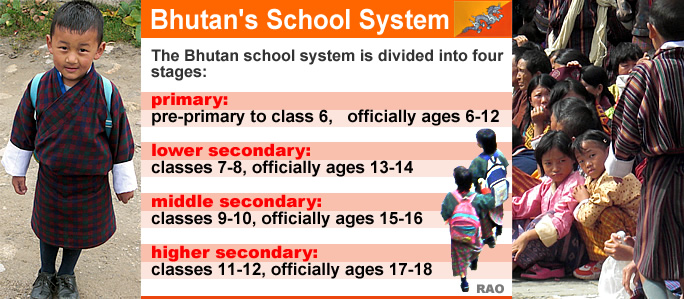
| Bhutan's
education system |
| Primary
and Secondary education |
 |
 |
| Primary
education incorporates one year of pre-primary education, which provides
an opportunity for all children to prepare for the formal education programme.
Secondly, it is generally accepted that the Bhutanese culture provides
a high level of interaction between children, parents and other family
members in the child's early formative years. The government has addressed
the issue through sectoral inputs in the areas of health, nutrition and
education. Nurseries and day-care centres are now being established by
the private sector in urban areas.
The
new constitution provides for 11 years of free basic education for every
Bhutanese child from pre-primary to class10. No tuition fees are charged
and rural children receive free stationery and textbooks, but education
can still be costly for parents because of the opportunity costs and lack
of cash income. |
|
 |
Government
policy is to provide primary-school facilities within walking distance
of all children's homes. As a result of government efforts, net primary
enrolment rates have increased compared with 2005, and are now 80 percent
for boys and girls. Net enrolment rates in Chukha, Gasa, Samtse and Tsirang
continue to be below the national average.
The
main reasons for children not attending school include:
 distances to rural schools: many primary schoolchildren walk up to two
hours each way; distances to rural schools: many primary schoolchildren walk up to two
hours each way;
associated costs: for low-income families the cost of school uniforms and
packed lunches are prohibitively high - for a quarter of rural families
this was the reason for not sending their children to school;
reliance on children for farm labour and household incomes - for a fifth
of rural families this was the reason for not sending children to school;
lack
of interest: school education is often seen as irrelevant; and
the perception in remote areas that girls' education is less important
than boys'.
Under
the WFP-supported school feeding programme, students in boarding schools
at primary, lower secondary, middle secondary, and higher secondary schools
receive breakfast, a mid-morning snack and lunch from WFP; dinner is provided
by a parental contribution for boarding pupils up to class 6, and by the
Government in the form of a cash payment called a "stipend" for boarding
students in class 7 and above and in a few primary boarding schools. Assistance
for boarding students currently accounts for half of WFP expenditure on
school feeding in Bhutan.
top
| Focus on Bhutan's Education System |
|
| more information on Bhutan |
|
| Links |
|
 |
|
External
links |
|