You are here:
Bhutan Information
Bhutan - Demographic, Economic & Social Statistics
Search RAOnline
Bhutan Statistics
Bhutan GIEWS global information and early warning system on food and agriculture
previous pageend
GIEWS - global information and early warning system on food and agriculture
GIEWS Country Brief Bhutan

Bhutan

Reference Date: 7-April-2011

FOOD SECURITY SNAPSHOT

- Outlook for 2011 winter wheat is favourable.

- Cereal production in 2010 recovered from poor harvest in 2009.

- Pockets of food insecurity persist.

Favourable prospects for the 2011 winter wheat harvest

Very little wheat is produced in this mountainous country but nonetheless the area planted has increased in past few years. Harvesting of the crop will begin shortly and will continue until the end of July. The snow/rainfall has been near normal this season and the early forecast points to an improved production.

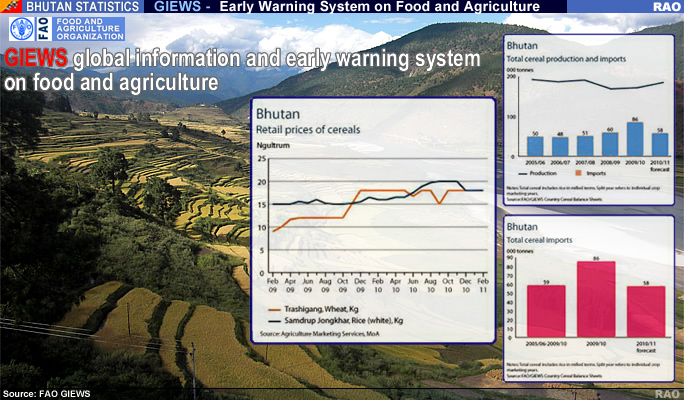
The 2010 total cereal production is estimated at 185 000 tonnes (including paddy), a recovery from the drought affected 2009 output. The generally favourable monsoon season last year was the main reason behind the eight percent increase in production in 2010.

Better cereal production in 2010 is expected to lower the import requirements for the 2010/11 marketing year (July/June). However, the rising per capita cereal consumption has resulted in a rising trend in cereal imports. Imports consist mainly of rice and wheat and are normally acquired on commercial basis from neighbouring India.
Food prices have stabilized at high level

Prices of cereals, particularly of rice and wheat, the main staple foods, have been rising significantly in recent months. Price of rice in particular had soared recently reportedly due to increased demand following the rise in the salaries of the civil servants. The price of rice seems to have settled down in January and February. Price of wheat on the other hand has remained generally stable.
Food insecurity exists in certain districts

According to the 2007 Bhutan Living Standard Survey Report, poverty and food insecurity prevail predominantly in Lhuntse, Samtse, Zhemgang and Monggar districts. Recent UNHCR information indicates that there are nearly 95 000 Bhutanese citizens of Nepali origin still living in seven refugee camps in south-eastern Nepal. Resettlement of refugees especially in the western countries is being implemented to solve this long standing problem.

External link
For additional information log on to
FAO GIEWS
Source: FAO GIEWS, April 2011

top

Information

top

Links
External links
FAO GIEWS
FAO
top
previous page
Bhutan HOME