|
Bhutan's Development Netherlands |
|
Bhutan Information |
|
|
 |
| Development: The Netherlands in Bhutan |
|
SNV
in Bhutan
|
 |
|
|
| Conservation
and development are often seen as antagonists, more conservation means
less development and vice versa. They are the exclusive domains of different
organisations, each holding their position and struggling to get the upper
hand. Many feel that SNV, as a development organisation should take side
in this: bring development into conservation, but not vice versa. A National
Park, an environmental action plan, or even the concept of sustainable
development should not stand in the way of the poor. The present document
aims to tell a different story. It is a case study on how conservation
and development can go hand in hand, more conservation leading to more
development. |
|
|
 |
 |
| Netherlands
Development Organisation |
|
An
important policy decision in Bhutan is that among these, emphasis is on
the first objective:
maintaining
the ecological integrity of the ecosystem as a whole, rather than species
protection. This is reflected in the creation of large Protected Areas
with relatively little human presence. |
|
top
|
Community
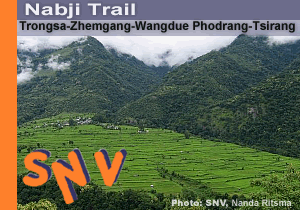
tourism along the Nabji Trail - Example of sustainable rural tourism
|
 |
| Community
tourism in Jigme Singye Wangchuck National Park |
A
team of DOT, NCD, ABTO and SNV staff decided to explore the possibility
of community-operated trekking trails that would provide additional income
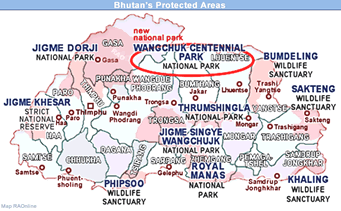
for local communities residing in the Jigme Singye Wangchuck National
Park (JSWPN) (Bhutan's protected areas),
which is located in one of the poorest districts in Bhutan. More than 90
per cent of the inhabitants of some villages inside the park lack self-sufficiency
in cereals, and their location inside a national park limits their opportunities
for earning cash income.
| Jigme
Singye Wangchuck National Park |
Community
tourism - Nabji Trail |
 |
 |
|
|
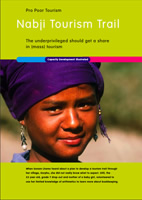
Brochure
|
|
 |
|
Source: SNV
|
Key
Achievements |
| 2240
KB |
 |
|
 In only three months, the project has generated an estimated US$ 7,000; In only three months, the project has generated an estimated US$ 7,000;
This amount is estimated to increase to about US$ 10,000 in 2007;
In 2006, approximately 210 households in six villages received a supplementary
income from the tourist trail;
Part of the income from the project was paid into the Community Development
Funds to fund communal expenses;
The project has shown great potential for increasing gender equality, although
this is yet to be fully realised.
Source:
SNV |
|
 |
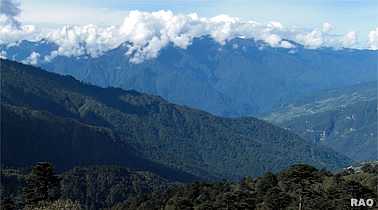
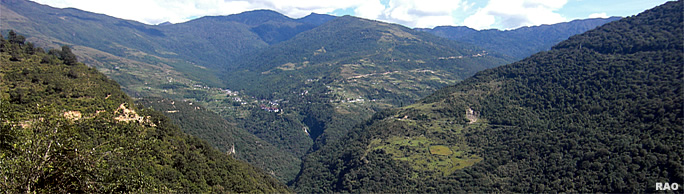
The
highlights of the Nabji trekking
trailinclude visits to small Bhutanese mountain villages and the Monpa
ethnic group, diverse forests of the park, and possible sightings
of endangered and vulnerable species such as the golden
langur and rufous-necked hornbill.
 |
| The
village communities along the trekking trail, namely the villages of Nimshong,
Nabji, Korphu, Kupdra/Phrumzor and Jangbi, have expressed enthusiasm
for the project and agreed to establish tourism management committees to
plan and manage sustainable tourism development.
The
committees are supported by the JSWNP staff, with the training, coaching
and technical advice of the SNV adviser, DoT and ABTO. |
|
|
|
Trongsa
|
 |
|
|
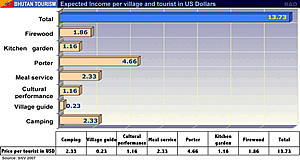
Expected
income per village and tourist
|
|
For
more information on Community tourism
along the Nabji Trail in the Jigme Singye Wangchuck National Park - An
example of sustainable rural tourism development in Bhutan:
|
|
| Source: SNV 2007 |
| Information on Bhutan |
|
|