 |
Bhutan's
Architecture |
|
|
Bhutan Information |
|
|
 |
| Village
Houses |
 |
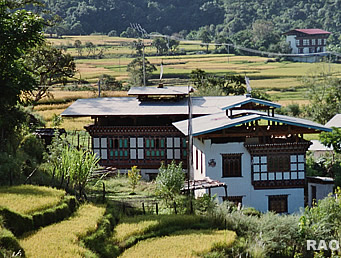 |
| Punakha Valley |
| Village
houses are not built of the same material all over the country. While the
western region favors compressed earth (mud) for the walls, the central
and eastern regions use stones.
In eastern
Bhutan, bamboo is an important raw material for any construction. In
southern Bhutan, houses have mud walls with thatched roofs. However, houses
all over the country display distinctive uniform features: rectangular
shape, two or three stories high, upper floors almost totally made of a
framework of wood and plastered bamboo panels, pitched roof and trefoil
shaped windows. |
|
The
upper floor is used as living quarters and private chapels while the lower
floor is used mainly for keeping domestic animals and for storage.
During
the past twenty years, the design and structure of the Bhutanese architecture
have changed, especially in urban areas due to the availability of new
materials like cement, steel rods, metal sheets and slates as well as due
to the change of purpose of the buildings.
In
urban houses, the ground floor these days is often used for shops. However,
the traditional features of architecture have been maintained. As for the
rural houses, they have improved tremendously. Glass paneled windows, smokeless
stoves and improved latrines are becoming more common; painted designs
are applied more and more lavishly; and the roofs are made of corrugated
metal. As with the dzongs, the rural houses also contribute in giving the
landscape in Bhutan its charm and uniqueness.
top
|
more
information on Bhutan
|

|
 |
|
Mo
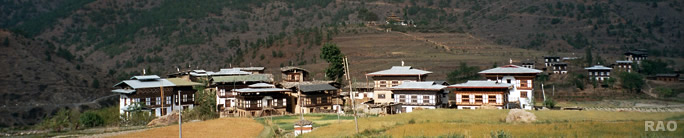
Chhu Valley |
|






