|
Bhutan's
Architecture |
|
|
Bhutan Information |
|
|
 |
| Different
types of Chortens |
| Mani-walls |
 |
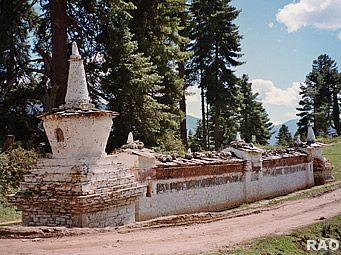 |
Mani-wall
| Mani-walls
are stone walls that support a number of stones carved with sacred formulas.
These formulas are either those of the three protective Bodhisattvas (Chenrezi,
Jampelyang and Chhana Dorje) or a simple prayer Om Mani Padme Hum, from
which the name has been derived. |
|
top
| Palaces |
|
|
|
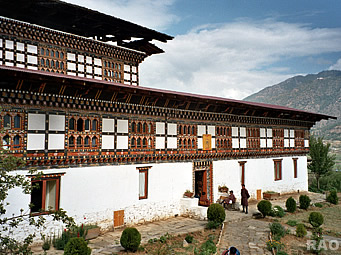
Gangtey Palace, Paro
| Construction
of palaces took place with the coming to power of the Wangchuck dynasty,
starting with Jigme Namgyal, the father of the first king. It can be explained
by the fact that from the end of the last century the country experienced
a period of stability and peace, and the need for fortress type Dzongs
had diminished.
Palaces
were built between 1870 and 1940 and are mostly found in the Bumthang and
Trongsa regions. Their basic pattern is very similar to that of a dzong.
A central building houses the residence of the master, and the upper floor,
the private chapel. |
|
It
is surrounded by a courtyard enclosed by an outer structure in which the
servants' quarters and the kitchen are located. The palaces have been richly
decorated with woodwork, and even the outer building has been embellished
with numerous painted windows.
|
more
information on Bhutan
|

|
|